



SHOPPING CART
Your cart is empty.
shop now
Your cart is empty.
shop now
Frustrated when your DSC results drift or show noise? Selecting the right research-grade crucible solves these common headaches and secures reliable data every time.
The most important technical specifications for research-grade DSC crucibles are material purity, precise geometry, sealing method, maximum temperature, and volume capacity. Choosing the correct specs ensures accurate, stable thermal analysis results.
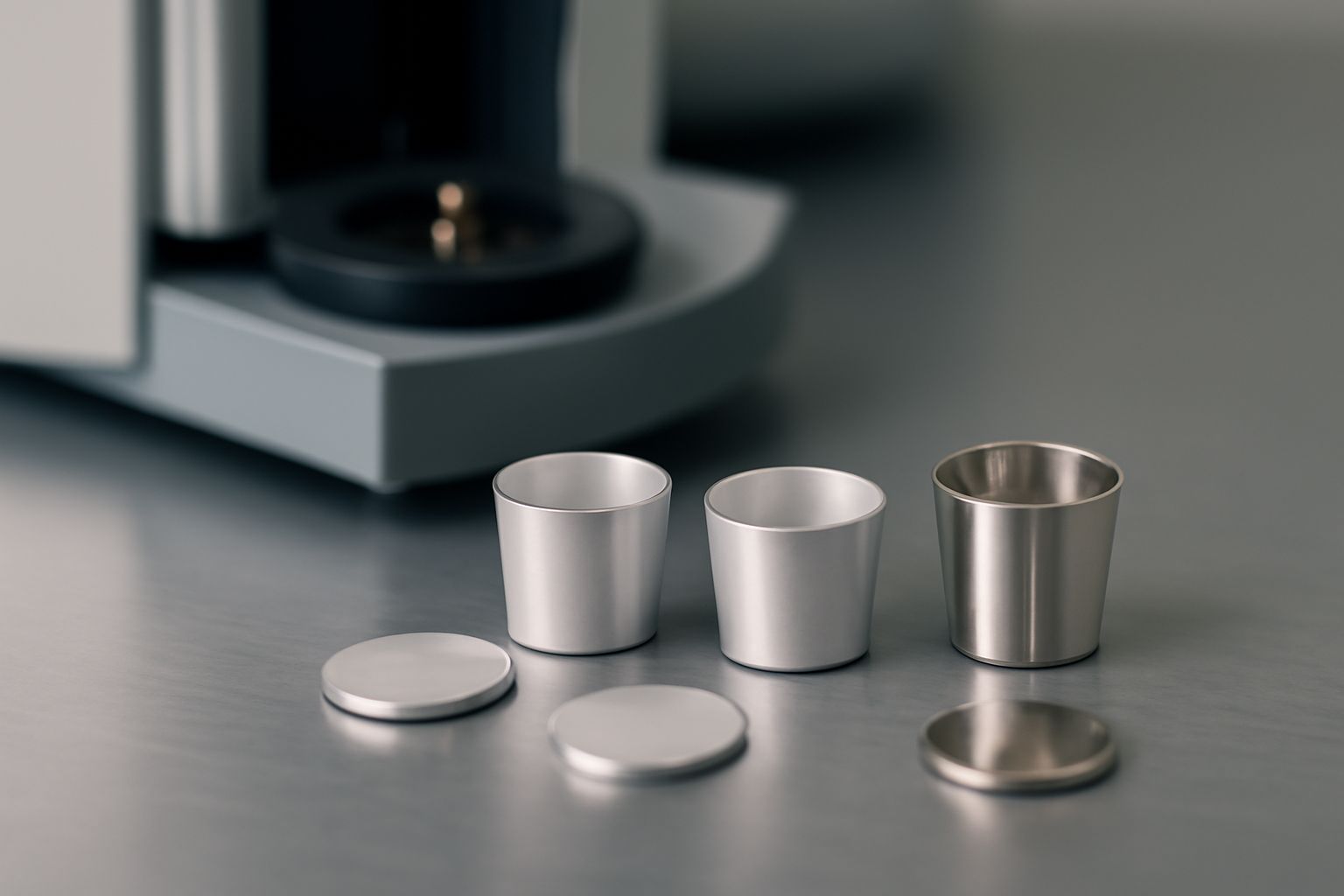
Many users ignore minor technical details, but even a small mismatch between crucible and test needs can spoil a whole research project. Exploring key specifications in depth helps users avoid errors and compare their options confidently.
Unstable baselines or random peaks in DSC outputs might be due to hidden impurities in crucible materials. This is one of the first things top labs check when results seem “off.”
Research-grade DSC crucibles stand out by using metals with purity as high as 99.99%. High-purity aluminum, platinum, or gold virtually eliminate background interference in sensitive measurements.
| Material | Typical Purity | Role in DSC | Best Use Case |
|---|---|---|---|
| Aluminum | ≥99.99% | Low heat capacity, minimal reactivity | Polymer, organic, general research |
| Platinum | ≥99.97% | High stability, non-corrosive | High-temp, aggressive samples |
| Gold | ≥99.99% | Extreme chemical resistance | Specialty, pharmaceutical work |
Purity matters because trace metals or non-metals inside the crucible can react or contribute extra heat signal. When building a research-grade process, most labs stick to high-purity standards to keep baselines flat and repeatable. For the best results across common DSC platforms like those from PerkinElmer or TA Instruments, always double-check the supplier's purity certificates (see ASTM E968 for reference).
Some labs get stuck with unclear melting points or broad peaks. Many times, these issues trace back to the shape and thickness of the DSC crucible—not just the machine or sample.
The shape, mass, lid fit, and wall thickness of a DSC crucible each change how heat travels, affects thermal lag, and shapes peak resolution in the final data.
| Design Aspect | Impact | Test Parameter Affected | Compatibility |
|---|---|---|---|
| Wall Thickness | Thicker walls slow heat flow; thinner increases sensitivity | Temperature response, lag | Needs to match DSC model |
| Pan Geometry | Shallow pans: Faster equilibration; deep pans: more capacity, slower | Peak sharpness, sample size | Tight fit for analyzer, especially with robotics |
| Lid/Seal Choice | Hermetic seals control volatile loss, open pans allow venting | Reproducibility, sample integrity | Required by method (e.g., volatiles, oxidizers) |
Matching crucible design to your heat flow and sensitivity needs improves data quality. For example, when working with rapid-melting polymers, shallow thin-walled crucibles reduce thermal lag. I always advise checking your instrument’s calibration status after changing to a new crucible design since even minor changes can shift the thermal baseline.
Many DSC failures happen during high-temperature ramps when standard crucibles start to deform or leak, throwing off results and sometimes damaging sensors.
Research-grade DSC crucibles often support maximum temperatures from 600°C up to 1600°C. The specific limit depends directly on the base metal and seal used.
| Crucible Material | Max Service Temperature | DSC Application | Failure Risk |
|---|---|---|---|
| Aluminum | ~650°C | Organic, polymer, moderate temp tests | Deforms above 650°C |
| Platinum | ~1600°C | Ceramics, metals, geologic samples | Corrodes only with halides or fused samples |
| Silver | ~900°C | Specialty polymer blends, TGA/STA extension | Tarnishes with sulfur content |
For standard research in polymer or pharmaceutical labs, I rely on aluminum pans but always respect their ~650°C upper limit. For more extreme processes or ceramic studies, platinum crucibles handle temperatures up to 1600°C without warping. Always verify the stated rating from credible sources—see melting point data by the American Chemical Society for reference.
Sometimes a DSC looks fine at room temperature, but leaks out or bursts above 100°C if the pan is not properly sealed. Volume sizing mistakes also alter baseline or waste precious sample.
Hermetic sealing prevents sample loss and external contamination, which is crucial for volatile compounds. The right volume ensures all sample melts or reacts as intended without spills or excess dead space.
| Parameter | Explanation | Why it Matters | Lab Example |
|---|---|---|---|
| Sealing Method | Hermetic (crimped), press fit, vented | Controls atmosphere, prevents mass loss | DSC with ethanol (volatile) |
| Volume Capacity | Ranges from 20–60 μL common, some custom up to 100μL | Right fill improves sensitivity, avoids baseline drift | Low mass dehydration tests use 20–30 μL |
| Sample Load Consistency | Precision weighing, matching empty pan mass | Improves reproducibility across multiple runs | Needed in pharmaceuticals |
When I set up DSC runs for volatile samples, I always favor hermetic pans with precise volume markings. Even a 5μL variation in fill can make certain peaks disappear or shift. Accurate sample weighing, lid crimping, and clean sealing boost data quality with all brands, not just REDTHERMO.
Getting stuck with poor data can usually be traced back to a mismatch in purity, temperature range, or pan design—problems that waste time and sample.
I always recommend choosing ≥99.99% metal purity, tight manufacturing tolerances, and the correct sealing type for your DSC method. Check for compatibility with your instrument model and confirm all certificates before ordering. Small technical details in crucible specs make the difference between publishable results and noisy or misleading curves.
| Specification | Why it Matters |
|---|---|
| Material Purity | Prevents unwanted background signals and sample reactions; key for reproducibility. |
| Geometric Precision | Assures correct fit and even temperature distribution. |
| Sealing Type | Protects sample integrity and matches your experiment’s design. |
| Temperature Tolerance | Keeps pans from deforming or leaking at high test ramps. |
| Compatibility List | Ensures quick switching between machines and brands (see manufacturer guides). |
Whenever I consult for a new lab project or see repeat DSC equipment failures, I start with a detailed crucible check. You can avoid lost hours and repeated tests by making material quality and design your first priorities. Learn more in the RedThermo compatibility reference guide or visit dedicated DSC method resources.


C082.Wangdefu International Building, Furong, Changsha, Hunan, China


+86-19907415020