



SHOPPING CART
Your cart is empty.
shop now
Your cart is empty.
shop now
Inconsistent results and failed experiments often happen because buyers overlook the technical details of DSC pans. Careful review of material, size, and sealing avoids data errors in thermal analysis.
Key technical specifications for compatible DSC pans include base material, pan size, temperature range, and the sealing mechanism. Understanding these will help any user achieve clear, repeatable, and accurate results in the laboratory.
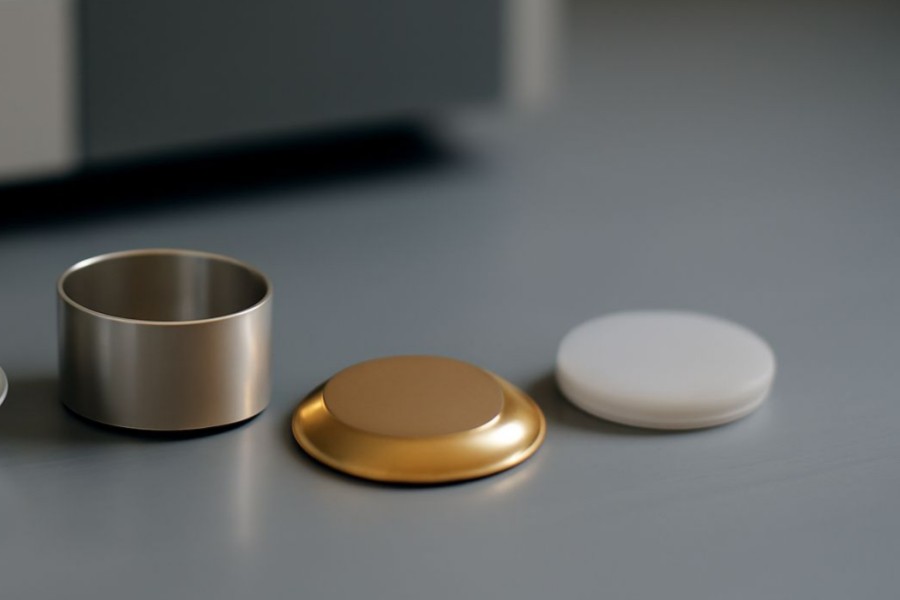
I have seen many labs improve repeatability by switching to pans with higher purity or better seals. If you aim to keep your data reliable, read on as I explain the main technical parameters in detail using tables for each topic.
Many people ask what makes a DSC pan universal. The answer starts with the right choice of material for reproducible and contamination-free testing.
Universal DSC pans are usually made from high-purity aluminum, platinum, or PTFE. These materials provide stable heat transfer, low reactivity, and reliable performance in most lab applications.
| Material | Advantages | Common Use | Reference |
|---|---|---|---|
| Aluminum (99.99%) | Good thermal response, low cost, easy to seal | General purpose, polymers, pharma | Aluminum |
| Platinum | High melting point, inert, long-life | High temp, precise alloy testing | Platinum |
| PTFE | Chemical-resistant, flexible, non-stick | Wet, corrosive, or reactive samples | PTFE |
| Gold-Plated | Ultra-clean, reduces sticking | Trace analysis, pharma, medical | Gold Study |
In my projects, the switch to platinum or gold-plated pans eliminated unusual background signals. Choosing the right material protects sensitive samples and improves data accuracy, especially in pharmaceutical and food safety labs. Most suppliers now provide clear specs for each material so users can match pans to their test type.
Lab results can become unstable simply because a pan is a fraction of a millimeter off from size requirements. Dimensions play a core role in pan - instrument match.
DSC pans must meet strict diameter, height, and wall thickness standards. Any mismatch may hinder device automation, sealing, or sensor contact, which leads to error-prone data or damaged equipment.
| Dimension | Standard Range | Effect on Compatibility | Reference |
|---|---|---|---|
| Diameter | 6.3 – 7.0 mm (typical) | Must fit sample holder and carousel | DSC |
| Height | 2.8 – 3.5 mm (open), 3.0 – 5.0 mm (sealed) | Critical for sealing and automation | REDTHERMO |
| Wall Thickness | 0.07 – 0.15 mm | Controls heat transfer and pan strength | Metal Thickness |
| Lid Shape | Flat, domed, vented (to match test purpose) | Improves sealing, prevents leaks | Machine Component |
Once, I ran a test on two sets of 6.5 mm pans—only one fit the automatic carousel without jamming. This led to a practice of always checking dimension tolerances in technical datasheets and asking suppliers for batch-to-batch inspection certificates. Accurate dimensions help make cross-brand compatibility much easier, especially with changing instruments or sample stages.
Pans built without proper temperature limits often deform or leak during heating. This destroys valuable samples and ruins thermal analysis results.
A compatible DSC pan should have a temperature tolerance that safely covers your method’s temperature range. Key limits are dictated by material—aluminum for up to 600°C, platinum for 1600°C, and PTFE for lower-temperature, special tests.
| Material | Rated Max Temperature | Ideal Use Case | Reference |
|---|---|---|---|
| Aluminum | ~600°C | Polymers, organics, pharma | Aluminum |
| Platinum | ~1600°C | Ceramics, metals, alloys | Platinum |
| Gold-plated | Up to 600°C | Trace residue or clean analysis | Gold Study |
| PTFE | ~250°C | Low-temperature, corrosive samples | PTFE |
I once helped a polymer R&D team solve deformation problems by switching from low-melting pans to high-purity aluminum. Knowing your method’s highest temperature makes it easy to match pans and avoid costly errors. Many suppliers give certificates noting max temperature and actual test data for each pan batch now.
Poor sealing causes volatile loss, sample leaks, or cross-contamination. I have seen failed runs simply from choosing an open lid when a hermetic seal was needed.
The right sealing mechanism prevents leaks and supports accurate, repeatable measurement. Choices include crimp, hermetic, and o-ring styles, with each serving different sample types and analysis needs.
| Sealing Type | Description | Best Application | Reference |
|---|---|---|---|
| Crimped Lid | Manual or machine pressed; tight but easy to open | General, non-volatile tests | Crimp |
| Hermetic Seal | Creates airtight closure, blocks moisture and gas | Volatile, sensitive, oxidation-prone samples | Hermetic Seal |
| O-Ring | Flexible rubber seal, often for high pressure | Gas samples or extreme temp/pressure cycles | O-ring |
| Snap-On Lid | Quick fit, easy use, less tight | Routine screening/automation | Lid |
In one pharmaceutical case, only a tight hermetic pan kept water from evaporating during DSC study. Wrong choices in sealing often create instability in results, especially for labs running volatile or air-sensitive samples. I now always confirm sealing type with both supplier and test method before any new application.
Knowing DSC pan materials, sizes, temperature limits, and seals ensures every sample run delivers strong, repeatable data for any compatible thermal analysis system.
Ask About Your DSC Pan Specs – Contact REDTHERMO

C082.Wangdefu International Building, Furong, Changsha, Hunan, China


+86-19907415020