



SHOPPING CART
Your cart is empty.
shop now
Your cart is empty.
shop now
Lab work falters without the right technical specs. Material choice and engineering details will affect your whole experiment, from start to final results.
Knowing technical parameters like material quality, temperature limits, and the option for customization sets the foundation for reliable and advanced thermal analysis in university labs.
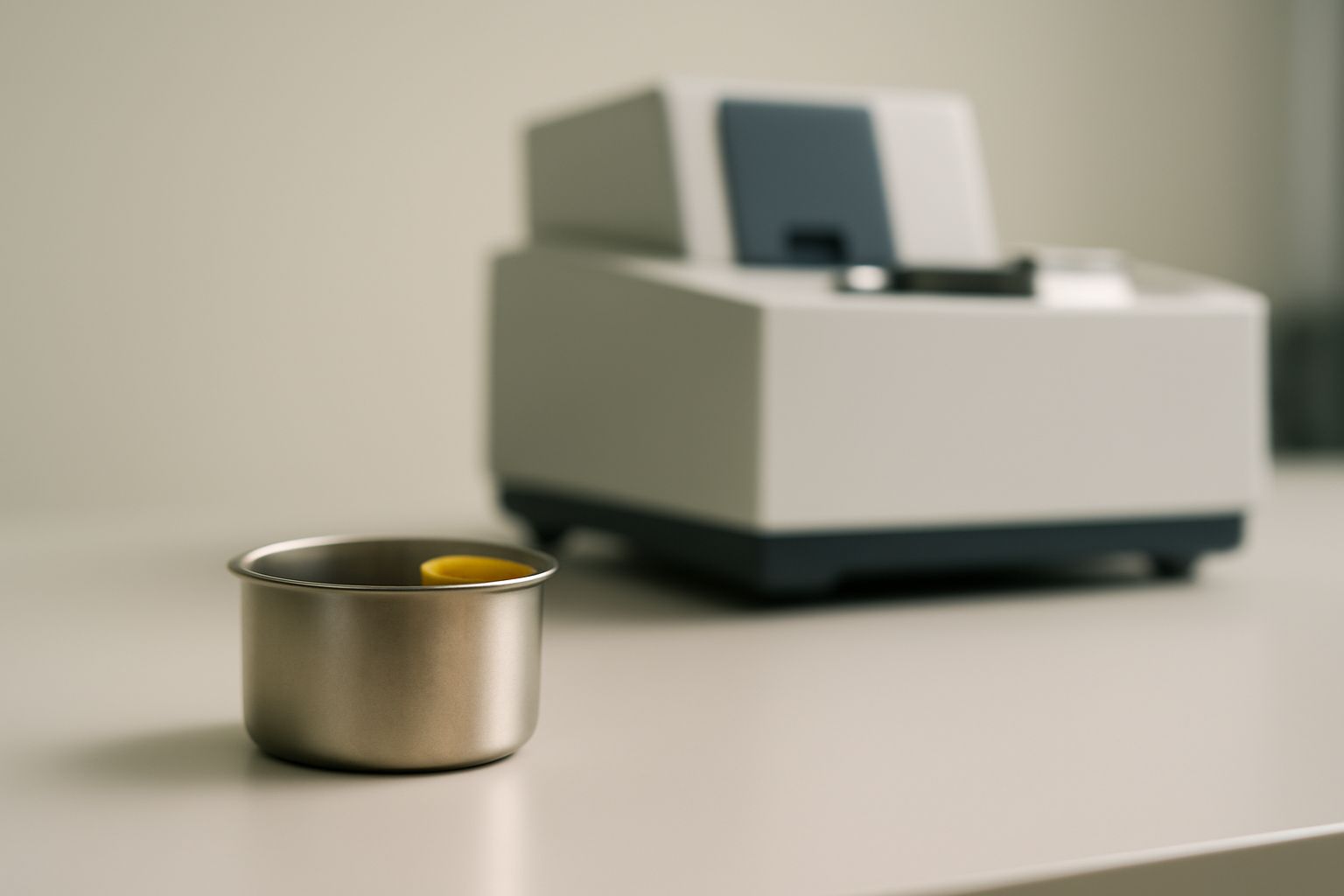
I compare many thermal analysis supplies for academic projects. Strict technical standards make the difference between repeatable data and failed tests. I want to share what I look for when selecting supplies for precision-driven research environments and explain why these factors matter.
Poor material quality distorts thermal data and often leads to expensive rework. High purity ensures every reading has scientific value.
Material quality in thermal analysis supplies prevents contamination, supports consistent heating, and ensures that every measurement meets research and industry standards.
| Aspect | Effect on Results | Example Material | Source |
|---|---|---|---|
| Purity | Low impurity means fewer contaminating signals | Aluminium (99.99%+) | Purity explained |
| Thermal conductivity | Uniform material prevents hot/cold spots inside pans or crucibles | Platinum, silver | ResearchGate |
| Chemical resistance | Reduces unwanted reactions between sample and container | PTFE, gold, ceramics | Chemical resistance |
Every semester, I see more accurate and reproducible data from pans made with higher grade raw materials. Poor quality introduces baseline drift, peak broadening, and shortens the life of both consumables and sensitive instruments. Labs working under strict research funding guidelines depend on solid technical specs to publish with confidence and avoid project overruns.
Choosing the wrong sample pan specs will stop your test or ruin your dataset. Specifications govern everything from compatibility to accuracy.
Look for pans with dimensions, material type, mass, and sealing options that meet your analyzer’s and project’s precise requirements.
| Specification | Why It Matters | Typical Value/Detail | Extra Resource |
|---|---|---|---|
| Dimensions & shape | Device fit, sample size, thermal response | Ø 6.7 mm, flat or deep | Compatibility Guide |
| Material specification | Analyte stability and heat transfer | Aluminum, platinum, PTFE | Crucible info |
| Mass tolerance | Consistent weighing; repeatable results | ±0.01 mg | Weighing scales |
| Sealing method | Volatile or air-sensitive sample protection | Pierceable, crimped, or O-ring | Sealing types |
In tests I help set up, a small mismatch in pan size can prevent the analyzer from running. My advice: always check fit with your own analyzer’s manual, ask for a drawing from your supplier, and compare weight tolerances to improve your measurement sensitivity.
Your sample pan or crucible must survive the highest and lowest temperatures of every planned experiment. Failure here means ruined data or even hardware damage.
Every supply should be rated for your full testing temperature range, whether for polymer melting, ceramic firing, or decomposition studies.
| Temperature Range | Suitable Supply Material | Use Case | Details |
|---|---|---|---|
| -80°C to 200°C | Aluminum, PTFE | Low-temp polymer and aqueous sample studies | PTFE |
| Room temp to 600°C | High-purity aluminum pans | Polymer melting, organic reactions | Aluminum properties |
| Above 1000°C | Platinum, ceramics | Inorganic, ash, and high-temperature kinetic analysis | Platinum use |
Many times, I have seen supplies warp or fail under high temperature due to cost savings on the wrong grade. Always read the temperature maximum in technical sheets to avoid interruptions and instrument repairs. Chart your lab’s routine ranges, and match every purchase to the highest likely temperature you will need.
No standard pan or crucible will work for every academic project. Custom options solve problems and enable more advanced research.
Customizing supplies (forms, sizes, surface finishes) lets university labs handle unique materials, optimize batch size and shape, and match non-standard instruments.
| Customization Option | Research Benefit | Info | External Resource |
|---|---|---|---|
| Non-standard size/design | Fits unique analyzers or optimizes sample throughput | Custom CAD/CAM design with supplier | Custom fabrication |
| Surface finish changes | Improves cleanability or sample release | PTFE coating, electropolishing | Surface finishing |
| Batch labeling & barcodes | Tracks source and experiment batch in teaching or group work | Pre-printed barcodes or QR codes | Barcode |
I recommend custom orders for research projects that push the limits of device specifications or require traceable workflow. Many times, a supplier can match unusual models or add features to simplify teaching and audits. Universities benefit most when they ask suppliers directly about custom options rather than only buy off-the-shelf listings for critical work.


C082.Wangdefu International Building, Furong, Changsha, Hunan, China


+86-19907415020