



SHOPPING CART
Your cart is empty.
shop now
Your cart is empty.
shop now
Data in DSC experiments will be unreliable if pans deform or react at high temperature. Labs often lose critical samples and waste funds without robust heat-resistant pans.
Heat-resistant pans in DSC experiments are essential because they prevent deformation or chemical changes during runs, guaranteeing accurate measurement of heat flow and real material properties.
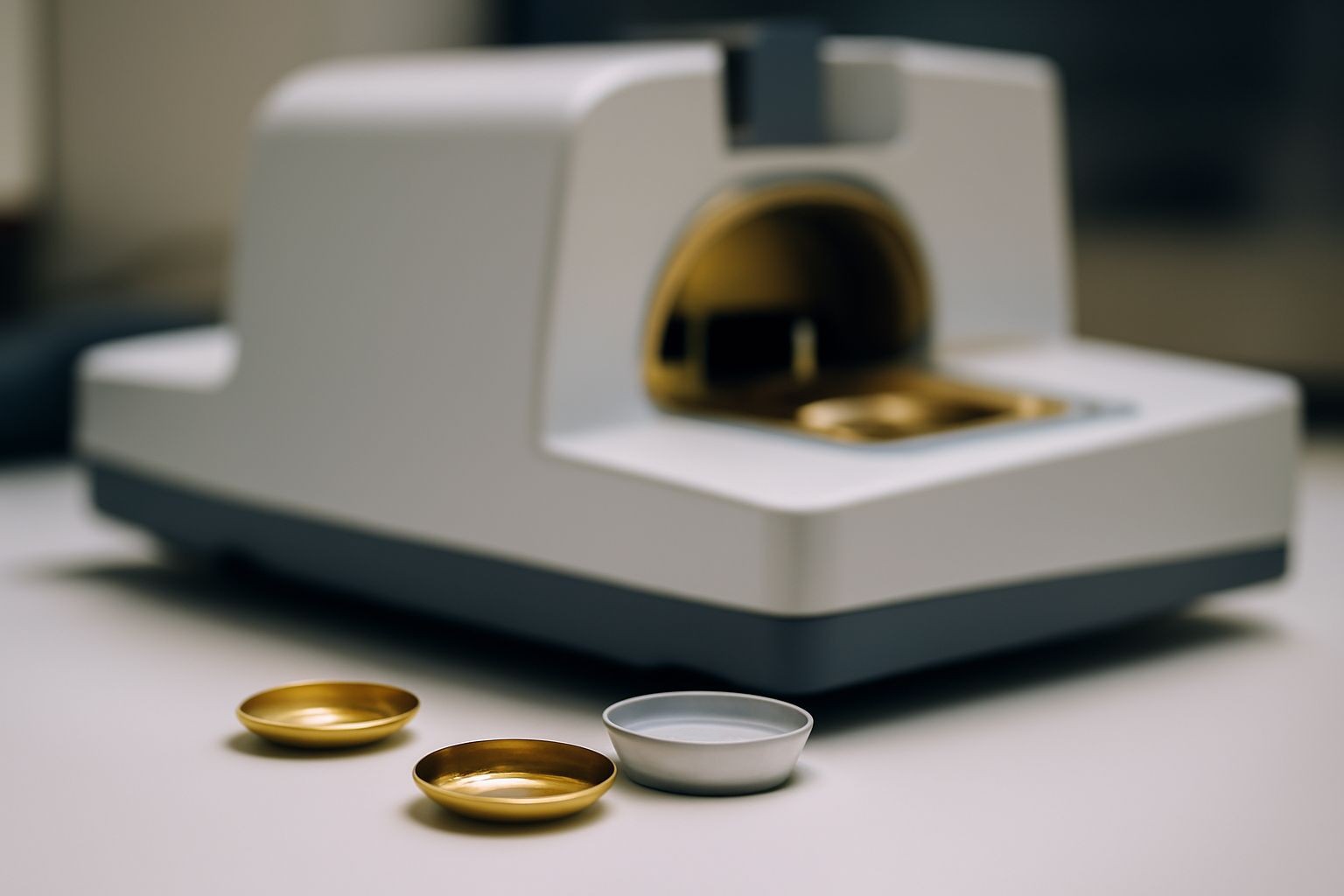
I work with material science labs and see the demand for reliable calorimetry in both research and industry. A poor-quality pan disrupts results and may even damage equipment. Careful selection of the right pan for both thermal stability and chemical compatibility gives every researcher solid ground for critical experiments. This article covers what makes heat-resistant pans essential and how they support the best practices in DSC analysis.
Unstable or reactive pans skew energy measurements in DSC. Many research projects rely on the durability of pans to handle repeated heating cycles.
Heat-resistant pans are necessary in DSC because they maintain shape and performance at high temperature, preventing data loss caused by deformation, fusion, or melting of the sample container.
| Core Function | DSC Impact | Typical Temperature | More Info |
|---|---|---|---|
| High temp stability | Prevents structure changes that would shift baselines | Up to 600°C or higher | DSC |
| Chemical inertness | Avoids sample reactions and side-peak creation | All temps, but key above 300°C | Inert gas |
| Consistent mass/geometry | Ensures repeatable heat flow between runs | Device/model matched | REDTHERMO guide |
I have managed projects that failed simple baseline tests until switching to better pans. Reliable heat resistance turns DSC from a trial-and-error method into a standard tool for material and process qualification, especially in regulated labs.
Accurate calorimetry relies on a supply that does not distort under experiment conditions. Pan performance is often the main difference between signal noise and clear peaks.
Reliable heat-resistant pans reduce baseline drift, minimize random noise, and support reproducible exo/endothermic transitions, all required for clear, interpretable DSC results.
| Factor | Accuracy Benefit | Effect on Data | Extra Reading |
|---|---|---|---|
| Uniformity of heat transfer | Reduces local heating or cold zones in sample volume | Sharper, more accurate melting peaks | Thermal conductivity |
| Minimal expansion/contraction | Protects instrument sensors and improves repeat run baseline | Lower baseline drift/noise | Thermal expansion |
| Contamination-free | Prevents false signal, especially in trace moisture or impurity studies | No spurious peaks or chemical shifts | Contamination |
I remember optimizing polymer crystallinity tests, where a single cheaper pan batch caused noise that obscured the glass transition step. After a switch to stable, inert pans, we saw clear and repeatable data—enough for publication. Material and thermal stability in the pan is non-negotiable for any DSC that needs to be trusted.
Material selection limits both experiment type and the lifetime of consumables. Labs put different value on purity, thermal limits, and cost for each study.
Top materials include high-purity aluminum, platinum, gold, and ultra-stable ceramics, each chosen for their resistance to oxidation, melting, or alteration.
| Material | Max Temp (°C) | Strengths | Typical Use |
|---|---|---|---|
| Aluminum (99.99%) | 600 | Widely compatible, low cost, good for polymers and organics | Routine melting or crystallization studies |
| Platinum | 1600 | Inert, ultra-high temp, resistant to corrosion/oxidation | Metals, high-temp ceramics, advanced R&D |
| Ceramic | >1100 | Excellent for ash, minerals, or aggressive chemicals | Ash, residue analysis, environmental tests |
| Gold-coated pans | 650 | Stable/inert, prevents sample adhesion or reaction | Moisture-sensitive or special pharma studies |
Through trial, I found that standard aluminum covers most classroom and general R&D needs, though platinum proves invaluable for high-end device qualification. Ceramics fill critical roles when examining decomposition or residue at extreme temperatures. Choosing the right pan starts with the experiment’s upper temperature and risk of reaction within the chosen matrix.
Poor pan choice can invalidate results or damage costly equipment. Labs need a clear selection method guided by project details, not only generic listings.
Select pans based on device compatibility, sample temperature range, chemical nature, experiment goals, and certification by a trusted supplier for your specific DSC model.
| Selection Criteria | Importance | Decision Guide | Further Advice |
|---|---|---|---|
| Model compatibility | Avoids jams, misreads, warranty loss | Use supplier or device guide before order | Compatibility Guide |
| Thermal limit/cycle | Lines up with hottest point in your analysis | Match pan temp rating to method | DSC basics |
| Sample chemistry | Ensures inertness, prevents pan/sample interaction | Cross-check with supplier table or MSDS | Safety sheet |
| Supplier validation | Guarantees batch-to-batch stability for trusted results | Ask for COA or QC printout | COA explanation |
I recommend working with suppliers who provide compatibility sheets, material data, and even trial samples when introducing a new pan in routine work. We always confirm the chosen pan’s spec before every new study, never relying on generic online listings. This reduces error rates, rework costs, and the risk of instrument failure for university and industrial projects alike.


C082.Wangdefu International Building, Furong, Changsha, Hunan, China


+86-19907415020