



SHOPPING CART
Your cart is empty.
shop now
Your cart is empty.
shop now
Using an incompatible or low-quality crucible can compromise your entire analysis. Choosing the right DSC crucible with lid is essential for accurate, secure laboratory results.
When purchasing DSC crucibles with lids, consider equipment compatibility, material durability, and supplier reliability. Lidded crucibles provide extra protection for sensitive samples and critical research work.
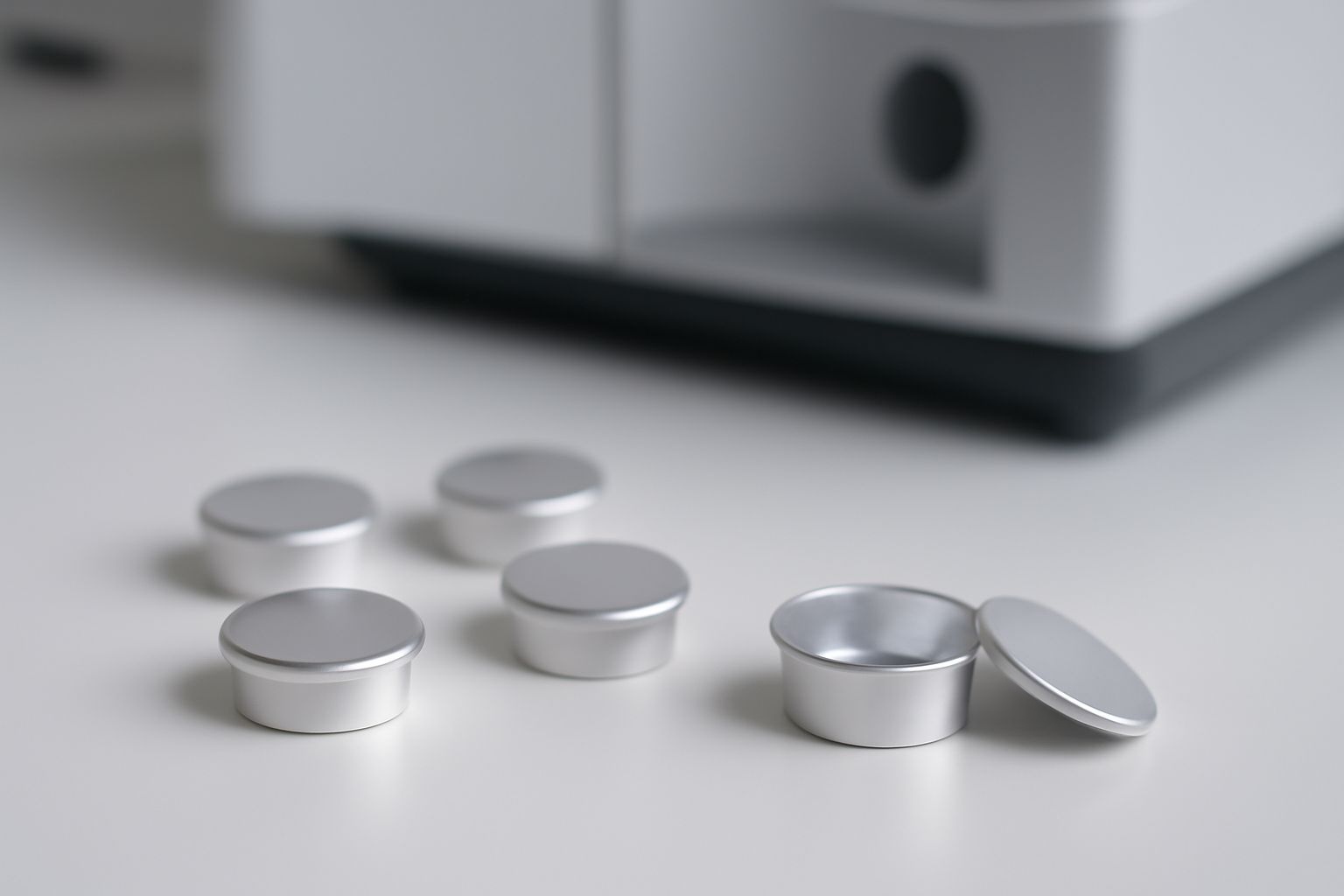
Working with many labs, I have learned that rushing crucible purchases leads to delays, wasted samples, and missed results. Careful consideration—especially for lidded crucibles—prevents sample loss and gives peace of mind for high-value projects in advanced R&D, polymers, and pharma. Below, I explain what truly matters when buying DSC crucibles for your next experiment.
Not every crucible fits every analyzer. Using mismatched pans risks test failure and machine damage, even when dimensions seem similar on paper.
Crucible compatibility depends on precise sizing, geometry, and material matching to the analyzer brand and model. Always consult the manufacturer or a trusted compatibility guide before purchasing.
| Equipment Brand | Key Fit Parameter | Check This First | Further Resource |
|---|---|---|---|
| NETZSCH / METTLER / TA | Diameter and rim profile | Reference lab model guide | Model Compatibility |
| Shimadzu, PerkinElmer | Height and lid design | Supplier-provided fit PDF | Calorimeter |
| Custom-made/legacy systems | Custom shape and alloy | Request custom prototype/test set | Custom fabrication |
When I purchased for a new device, I always confirmed the correct reference code by double-checking both the supplier matrix and the analyzer manual. Newer and legacy equipment sometimes requires sample purchases or test sets to ensure a secure fit and repeatable measurements.
Key features can make or break your test’s reliability—especially for volatile or hard-to-handle samples.
Look for material purity, seal efficiency, thermal resistance, consistent batch tolerances, and a reliable fit for the correct lid/crimping system. Avoid generics that lack technical data.
| Feature | Why It Matters | Best Value For | Related Topic |
|---|---|---|---|
| High purity alloy | Reduces background noise, prevents reaction | Polymer, pharma, high-purity studies | Aluminum |
| Advanced lid sealing | Protects volatile or sensitive contents, sharpens peaks | Moisture, low-melt, or active pharma | Sealing |
| Batch tolerance | Prevents variation, supports reproducible data | QA labs, compliance | Quality control |
| Lid fit and tool compatibility | Consistent crimp/seal, less sample loss | Routine, automated, and regulated analysis | Automation |
At my lab, thorough inspection of every new crucible lot for alloy analysis, tight lid tolerance, and geometric conformity prevented experiment failures. I recommend keeping at least one certificate of analysis/quality per batch for audit and support cases.
Not all vendors are created equal. Sourcing from unverified suppliers raises risk of failed tests and delayed deliveries.
The best sources are specialized providers like REDTHERMO, direct channels from analyzer manufacturers, or leading scientific supply houses offering compatibility matrices and fast technical support.
| Vendor Type | Main Strength | Lab Use Case | Product Link |
|---|---|---|---|
| Specialized pan/crucible suppliers | Model compatibility checks, custom solutions | All R&D, academic, pharma | REDTHERMO |
| Analyzer OEM channels | Certified, warranty-supported stock | QA, regulated labs | OEM |
| Reputable lab supply houses | Bundles, quick shipping, solid return policy | Routine, high-volume, teaching | Lab supply |
I use specialized suppliers or OEMs for new setups, while general supply houses serve as backups for schedule crunches. Ask for current compatibility matrices, review peer lab feedback, and verify technical support turnaround before switching suppliers.
Not all lidded or covered pans guarantee the same protection and performance for demanding analysis of volatiles or low-mass samples.
Crucibles specifically engineered with integrated, tight-fitting lids prevent vapor escape and contamination better than simple covers, supporting the highest data reliability for critical thermal studies.
| Crucible Type | Protection Level | Best Use | Further Info |
|---|---|---|---|
| Engineered (true) DSC crucible with sealing lid | Max protection, best reproducibility | Trace/moisture, high-accuracy, regulated labs | Calorimeter |
| Simple covered pan | Moderate, risk of leakage/contamination | Bench screening, short-term | Sealing |
| Open (no lid) pan | None, high sample loss, unreliable for most QA | Stable, nonvolatile or routine classroom use | Quality control |
For pharmaceutical and low-mass polymer work, our team now uses only certified lidded crucibles. This method consistently yielded sharper peaks, lower background, and zero contamination events, unlike simpler covered or open alternatives.


C082.Wangdefu International Building, Furong, Changsha, Hunan, China


+86-19907415020