



SHOPPING CART
Your cart is empty.
shop now
Your cart is empty.
shop now
Test failures are costly and frustrating—understanding crucible specifications helps prevent errors and ensures compatibility with your DSC methods and equipment.
Knowing the standard sizes, thermal stability, lid material properties, and manufacturing standards is essential for choosing DSC crucibles that will support accurate and reproducible calorimetry results.
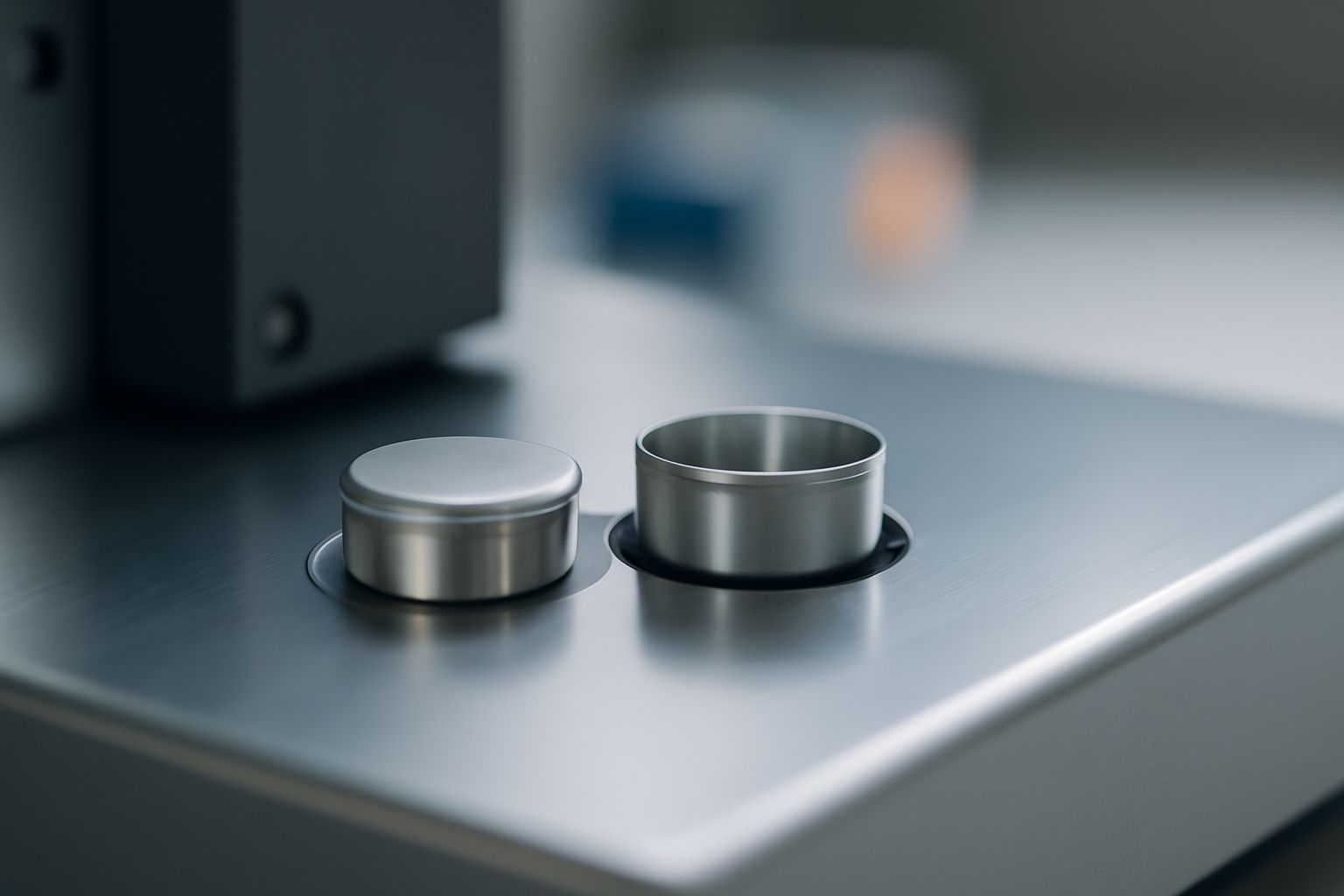
I have managed DSC projects where ignoring specification details led to wasted experiments or even damaged analyzers. This article offers a focused guide to evaluating and selecting DSC crucibles and lids based on technical parameters and compliance with industry standards, improving confidence in every analysis run.
Using the wrong size crucible can prevent proper fitting, cause leaks, or skew baseline readings, which can compromise the experiment.
Standard DSC crucible sizes are defined by inner/outer diameters, depth, and volume capacity, which must match the instrument’s pan support and thermal analysis requirements.
| Parameter | Common Size/Range | Purpose | Reference |
|---|---|---|---|
| Outer diameter | 6.7–7.0 mm (most brands) | Instrument compatibility, secure placement | Compatibility Guide |
| Volume | 20–40 μL (standard); custom to 80 μL+ | Sample size, heat flow accuracy | Calorimetry |
| Height | 2.2–3.0 mm | Accommodates lid, prevents overflow | Calorimeter |
| Wall thickness | 0.08–0.15 mm | Ensures uniform heating and mechanical strength | Wall thickness |
Each time I set up a new DSC device, I review supplier drawings and test fit a small batch. I keep reject logs when off-dimension pans are detected on delivery, catching specification problems before analysis begins.
Poor thermal stability leads to warping or even melting in the DSC oven, which distorts data and can harm the instrument.
Evaluate stability by checking maximum temperature ratings, alloy type, and prior user feedback for tested resistance to repeated heating/cooling cycles.
| Crucible Material | Max Temp (°C) | Resistance to Warping | More Info |
|---|---|---|---|
| 99.99% Aluminum | 600 | Good for most polymers, but not for metal testing | Aluminum |
| Platinum | 1600 | Excellent stability, reusable for advanced work | Platinum |
| Ceramic | 1300–1500 | Outstanding for strong acid/base or ash testing | Ceramic |
| Gold-coated | 600–650 | Resistant to oxidation, often for pharmaceutical/sample purity | Gold |
I run test cycles on new crucible batches to pre-qualify their use, observing for any change in mass or shape after heating. Recording every result helps track supplier consistency and flag issues during audits.
The lid is not merely a cover. Its design and composition directly affect measurement quality, sample integrity, and safety in the DSC process.
Lid material should match the pan and suit experiment specifics. Materials like aluminum, gold, or PTFE are selected based on thermal resistance, chemical compatibility, and required sealing performance.
| Lid Material | Key Property | Use Case | Extra Info |
|---|---|---|---|
| Aluminum | Matches standard pans, moderate sealing, cost-effective | Routine screenings, teaching | Aluminum |
| Gold | High inertness, best for purity-critical or volatile work | Pharmaceutical analysis, moisture studies | Gold |
| PTFE | Chemical resistance, non-stick, low vapor retention | Reactive or sticky samples, specialty protocols | PTFE |
| Ceramic | Max temp and chemical proof | High-temp, harsh solvents, or ash analysis | Ceramic |
I found that moisture-sensitive APIs demanded gold or specialized PTFE lids—a change that improved both result reproducibility and pan longevity in my department. Reviewing supplier test data for lid material is part of my pan selection checklist.
Consistent analysis requires pans and lids made to tight technical standards and certified in line with international protocols.
Manufacturing standards such as ISO 11357 and ASTM E1356 specify pan tolerances, purity, documentation, and test reporting; ensure suppliers provide product certificates and test lot samples.
| Standard Name | Scope | Required Supplier Data | Public Link |
|---|---|---|---|
| ISO 11357 | DSC methodology, pan specs, accuracy | Pan/lid drawing, QC/batch test report | ISO 11357 |
| ASTM E1356 | Glass transition temp and pan use | Performance certification, calibration data | ASTM E1356 |
| REACH/RoHS | Materials/chemical limits in components | Safety certificate, compliance declaration | RoHS |
I always file all certificates and lot-batch test data from my suppliers. These records avoid costly disputes or method repeat requests during audits or collaborative projects. Industry trend: more labs now request PDF certificates for each pan and lid lot as standard practice.


C082.Wangdefu International Building, Furong, Changsha, Hunan, China


+86-19907415020