



SHOPPING CART
Your cart is empty.
shop now
Your cart is empty.
shop now
Errors in thermal analysis waste time and money in labs. Many problems come from using unsuitable aluminum crucibles for DSC measurements.
When choosing aluminum crucibles for DSC, it is vital to check purity, exact equipment compatibility, wall thickness, and safe temperature range. Choosing the right specs means more reliable and repeatable test outcomes.
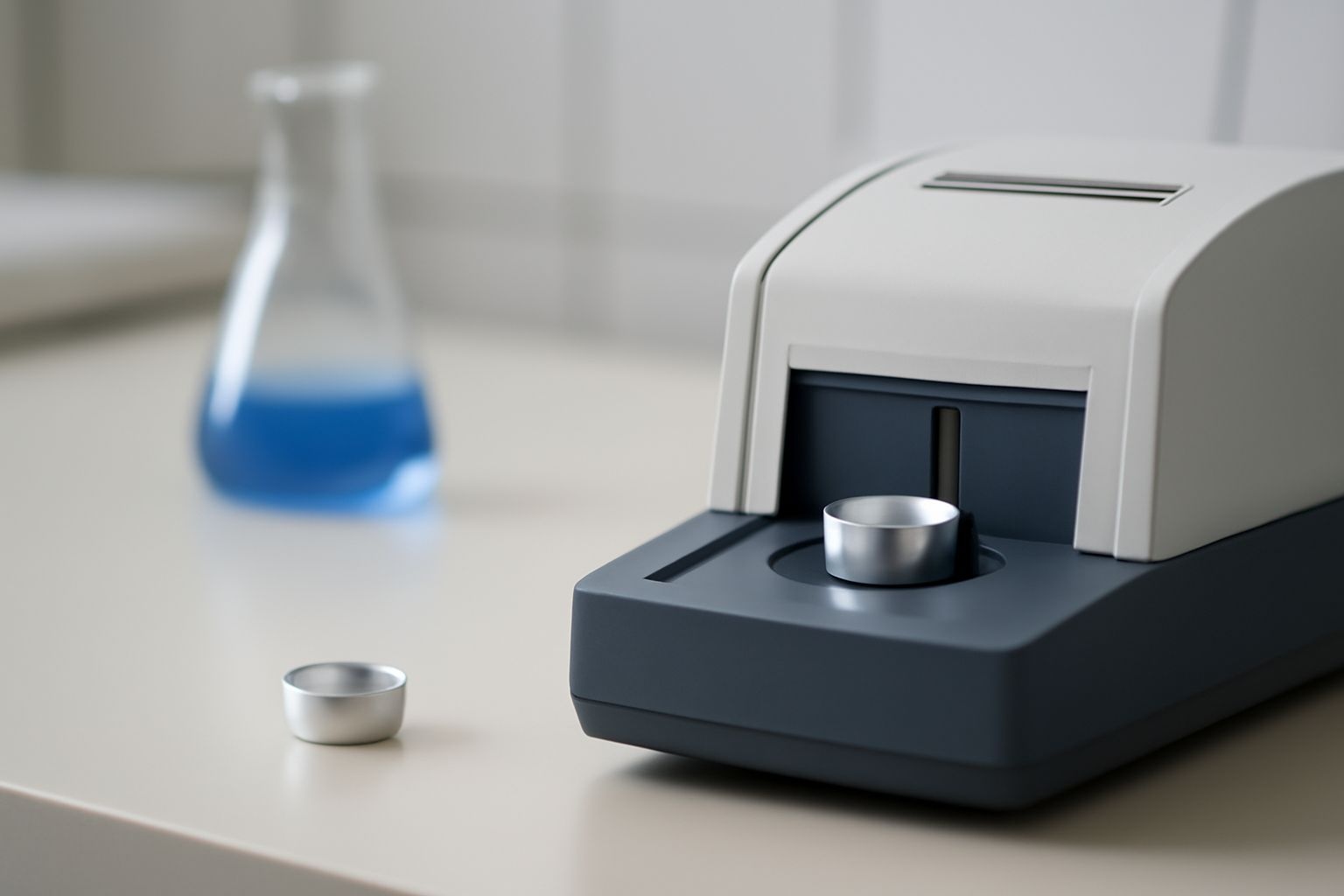
I have seen how small changes in crucible dimensions, material grade, or matching with DSC models can make results noisy or shift entire baselines. I want to help others avoid these easy mistakes by breaking down the most important specs before purchase.
Sample contamination ruins thermal data and costs labs valuable time. Many do not realize minor impurities in a crucible can react with sensitive samples.
High-purity aluminum crucibles (99.99%) reduce risk of adverse chemical reactions and deliver stable heat flow, which is critical for high-precision DSC analysis.
| Purity Level | Main Features | Use Case |
|---|---|---|
| 99.99% (high-purity) | Very low contaminant content, chemically stable | Pharma, sensitive polymer, trace analysis |
| 99.5% (standard lab grade) | Minor traces of non-reactive metals | Routine QC, standard research |
| Industrial/Unknown | Could contain unwanted trace elements | Non-critical, non-reproducible work |
I have watched customers struggle with baseline drift, only to find out their crucible purity was too low. High-purity options cost more but save far more in reliable, repeatable science. Learn more about aluminum alloys and purity at Wikipedia.
Bad fits between crucibles and DSC trays make for unstable results and hardware problems. Each DSC instrument model has its own accepted crucible dimensions.
Crucible height, rim diameter, and base curvature should match the device specification exactly. This keeps tests consistent and prevents calibration or handling errors.
| Parameter | Importance | Spec Guide |
|---|---|---|
| Outer rim diameter | Ensures seating on DSC carousel | Follow manufacturer datasheet (DSC models) |
| Height | Controls pan volume and sealing | Check match before each test |
| Base shape (flat, convex) | Affects thermal contact and baseline | Choose by instrument type |
| Compatibility with seal/lid | Needed for volatile or sensitive material | Order together for special runs |
I have handled cases where a few tenths of a millimeter led to wrong results or instrument jams. My advice is always match crucibles using the official compatibility chart—mixing sizes or shapes is not worth the risk. Most big brands like or TA post open-size lists for cross-checking. For more on DSC equipment, see Wikipedia.
Crucible wall thickness is often overlooked but can change both test speed and end result. Too thin or too thick pans miss accuracy or rapid thermal response.
Choose thickness based on your method’s balance between sensitivity and structural durability. Correct thickness brings best heat flow while resisting warping under thermal cycles.
| Wall Thickness | Advantage | Limitation |
|---|---|---|
| 0.08–0.12 mm (Thin) | Fast thermal response, high sensitivity | Can buckle on high temp or large volume runs |
| 0.13–0.18 mm (Standard) | Good durability, stable baselines | Typical for most DSC applications |
| 0.20 mm+ (Thick) | Extra strength for heavy or corrosive samples | Slower to respond, absorbs extra heat (heat capacity) |
I once ran the same DSC test in two crucibles of different thickness—thin-walled showed faster peaks but deformed at 600℃, while standard held shape with only minor response delay. Finding the middle ground gives best accuracy and lifespan. Read more about heat capacity at Wikipedia.
Running DSC too close to the crucible’s melting point leads to pan failure and lost samples. Safety margins protect sensitive and valuable data sets.
Most aluminum crucibles can work safely up to 600℃, but special alloys or designs might allow higher. Always check exact melting and softening temperature before a run.
| Aluminum Type | Max Safe Test Temp | Application Note |
|---|---|---|
| Standard lab grade | Up to 600℃ | Polymers, organics, moderate heating needed |
| High-temp alloy | 650–700℃ | Inorganic, advanced material checks |
| Mixed alloys/special | 700℃ + | Rare, often for custom experiments (melting point) |
I always look at both the instrument and the crucible spec sheet—some users get higher readings, but I never risk sample loss to save a few minutes. For more about material melting points, see Wikipedia.
The right aluminum crucible keeps DSC results clean and reproducible. Always check purity, fit, thickness, and temperature range for every purchase to protect your research investment.
Contact Technical Support – info@redthermo.com

C082.Wangdefu International Building, Furong, Changsha, Hunan, China


+86-19907415020