



SHOPPING CART
Your cart is empty.
shop now
Your cart is empty.
shop now
Material science breakthroughs start with careful measurement and sample control. Poor testing tools can delay research and compromise reliability in demanding laboratory settings.
DSC crucibles with lids ensure better accuracy in calorimetry by minimizing contamination and providing optimal thermal protection, key for consistent material science testing results.
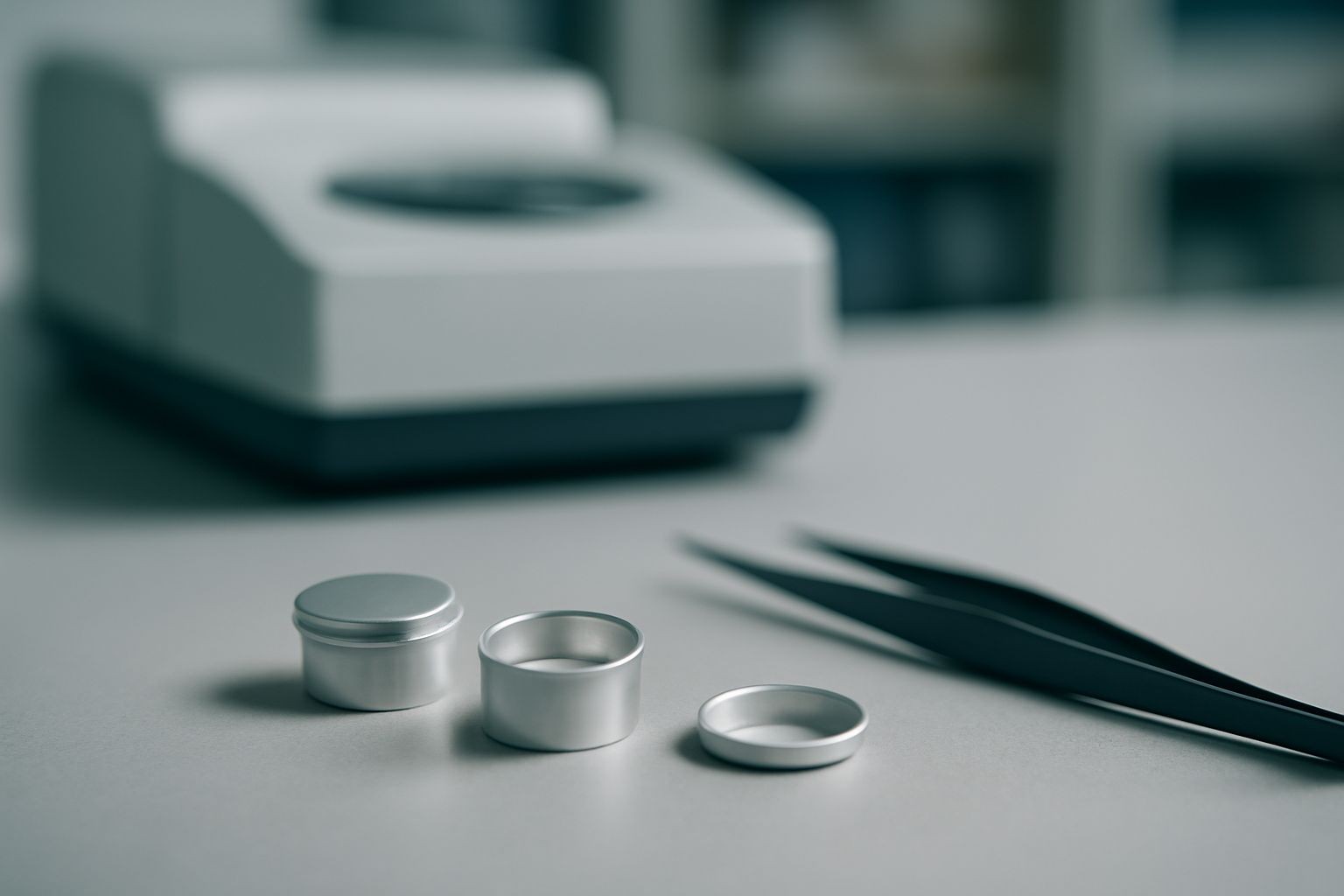
I have advised materials labs where switching to DSC crucibles with well-designed lids delivered more robust, repeatable data and reduced troubleshooting time. For teams exploring polymer, pharmaceutical, or alloy properties, the right pans plus smart sealing practices transformed their approach and opened the door to complex thermal studies. This article draws from those experiences to guide material scientists toward better analytical outcomes.
Across universities and R&D labs, DSC crucibles are fundamental to the study of heat flow and phase transitions in a wide range of advanced materials.
DSC crucibles serve as the sample containers for differential scanning calorimetry, which quantifies thermal events like melting, crystallization, and reactions in polymers, metals, and composites.
| Material Science Task | DSC Crucible Role | Common Sample Type | Reference |
|---|---|---|---|
| Phase transition measurement | Contains sample for precise temperature ramps | Polymers, nanocomposites | DSC |
| Purity and melting point analysis | Prevents interaction, ensures clean melting curves | Organic/inorganic solids | Melting point |
| Oxidation/reaction studies | Allows controlled gas or vapor containment | Reactive metals/alloys | Oxidation |
In my daily work, using lidded crucibles reduced sample loss during vigorous transitions, allowing us to explore complex properties in both cutting-edge and classic materials. Direct benefits included more accurate start and endpoint detection—very useful for quality control and R&D teams alike.
Without lids, samples lose mass or pick up contaminants, leading to unreliable calorimetric results and poor reproducibility—frustrating for both novice and seasoned researchers.
Researchers prefer DSC crucibles with lids for better sample isolation, control of volatiles, protection during high-temp analysis, and a lower risk of spurious exothermic or endothermic events.
| Advantage | Experimental Effect | Research Setting | Link |
|---|---|---|---|
| Minimizes contamination | Reduces exposure to air and moisture | Pharmaceuticals, hygroscopic polymers | Contamination |
| Improves thermal isolation | Sharpened heat flow peaks for subtle events | Phase-change and glass transition tests | Thermal insulation |
| Controls volatile loss | Keeps light compounds from escaping at elevated temperatures | Solvent-based systems, low-T melts | Volatility |
| Supports reproducible results | Better baseline stability across repeated trials | Routine QA, method validation | Reproducibility |
Switching to lidded crucibles in my research boosted our acceptance rate for first-time tests. Lid designs made it easier to follow SOPs for new materials—especially those prone to rapid volatility or contamination from air, providing both cost and time savings in long-term projects.
Certain materials require the precision and containment offered by lidded DSC crucibles for meaningful characterization and quality assessment.
Ideal analytes for DSC crucibles with lids include polymers, pharmaceuticals, fine powders, metals, alloys, and advanced composites—all needing thermal protection and conserved sample mass.
| Material Type | Key Requirement | Crucible/Lid Benefit | Topic |
|---|---|---|---|
| Polymers/blends | Monomer, copolymer purity; glass transition | Protects against oxidation; allows airtight crimping | Polymer |
| Fine powders | Low mass, high surface area, easy loss risk | Lid prevents scatter/sublimation at heat | Powder |
| Drugs/actives | Moisture sensitivity, low melting points | Supports sealed calibration with volatile testing | API |
| Metals/alloys | High T, reactive or volatile during melting | Withstands temp spikes, blocks metal vapor escape | Alloy |
| Composites/laminates | Multiple phase changes, hard to benchmark | Aids clear peak separation, repeat study setups | Composite |
Our team developed new composite coatings and thin films using only lidded pans, as they allowed us to tune heating rates and reveal minute events that open samples or low mass alternatives could not detect safely or reliably.
Technology in DSC pans and lids continues to evolve, adapting to new research needs and regulatory demands for precision and clean data.
Recent advances include gold or ceramic coatings, smart barcoding for audit, higher-pressure lid/cap options for volatile samples, and hybrid pan designs for new generations of DSC devices.
| Innovation | Key Feature | User Benefit | Reference Topic |
|---|---|---|---|
| Ceramic-coated crucibles | Ultra-high temperature/harsh chemical compatibility | Durability, less contamination, easier cleaning | Ceramic |
| Smart barcode tracking | Trace lot, sample, experiment data/recall | Audit, QA compliance | Barcode |
| Advanced lid sealing | O-ring, higher-pressure, custom-fit | Perfect for pharma, volatiles, environmental samples | Sealing |
| Hybrid (multi-layer) pans | Polymer/metal/ceramic composites | Wider analyte use, cost/longevity balance | Composite |
Recently, integrating barcoded ceramic-coated crucibles into our automated lab setup minimized lost samples and accelerated report writing. These technologies are now being adopted in both university and industrial QA labs to meet new compliance requirements and deliver robust, publishable data.


C082.Wangdefu International Building, Furong, Changsha, Hunan, China


+86-19907415020