


SHOPPING CART
Your cart is empty.
shop now
Your cart is empty.
shop now
Many hobby scientists want accurate results at home, but choosing professional accessories for their setup can feel daunting and expensive.
Hobby scientists and home labs only need a few key thermal analysis accessories, including compatible sample pans, lids, and holders, matched to their common experiments and safety standards.
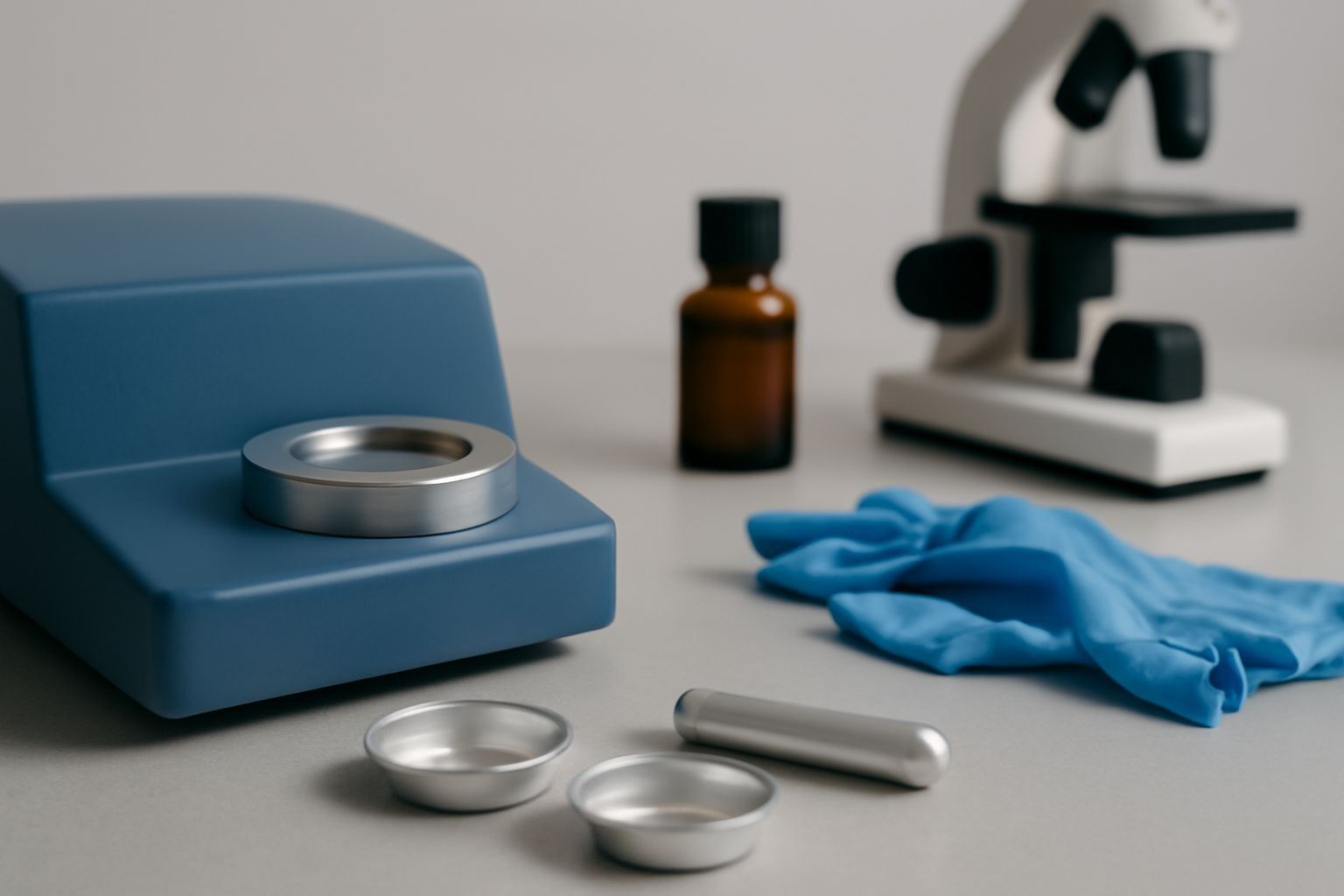
Building a home lab means focusing on the tools that give you both flexibility and trustworthy results. Let’s see which accessories deserve your attention and budget so you can make smart, safe choices for your next project.
Many people who run home labs feel overwhelmed by options. They want just enough gear—not too much, not too little.
The most used thermal analysis accessories in personal labs are standard sample pans (especially aluminum for DSC), secure lids, and simple pan holders that fit with compact benchtop devices or DIY setups.
| Accessory | Function | Typical Material | Why It's Used at Home |
|---|---|---|---|
| Aluminum Sample Pans | Hold test samples evenly for DSC or TGA | Aluminum (99.99% pure) | Reliable, low-cost, ideal for single-use, fits many experiments |
| Sealing Lids | Cover pans, control sample atmosphere, prevent loss | Aluminum, snap-fit or crimped | Safe for volatile samples, simple to apply by hand |
| Pan Holders / Supports | Hold pans fixed in device, avoid spills | Stainless Steel, engineered plastics | Guarantees fit, durable in DIY and reused setups |
| Reference Material | Calibration checks for test accuracy | Pure metals (Indium, Tin) | Makes sure readings are repeatable |
| Disposable Gloves | User protection, keeps pans clean | Nitrile or latex | Builds in basic safety, prevents test contamination |
Most DIY labs run tests like melting point, simple thermal stability, or polymer checks, so they mostly need basic accessories seen above. Anything more can quickly raise both costs and complexity. For reference values on melting points or calibration, I always look up current data on trusted resources like NIST (National Institute of Standards and Technology).
Building a home lab means keeping each experiment safe and effective. Choosing the wrong accessory can ruin results or risk a failed test.
Accessory selection in DIY labs depends on the experiment. High-temperature tests need metal pans, while sensitive or low-mass samples benefit from smaller, high-purity crucibles or specialized lids to prevent evaporation.
| Experiment Type | Recommended Accessory | Reason | Notes |
|---|---|---|---|
| Melting Point Testing | Standard sealed aluminum pans | Contain low-viscosity melts, avoid splatter | For pure substances or small samples |
| Thermal Decomposition | Open or vented pans, robust holders | Allows off-gassing, prevents pressure build-up | Never use tight lids with volatile samples |
| Polymer Analysis | Crimped pans with high-seal lids | Protects samples prone to oxidation | Often run under nitrogen (inert gas) |
| Moisture Content | Open pans, high surface area | Allows full evaporation measurement | Keep good airflow in lab |
| Oxidation Onset | Sealed pans, special atmosphere | Test under controlled oxygen or nitrogen | Use thick-wall pans for safety |
Different heating profiles or atmospheres will often call for another pan or lid type. This is one reason why a modular set of pans and lids saves money for small labs. For deeper reading, the thermal analysis entry on Wikipedia gives a thorough overview of technique types and their usual sample environment.
Some projects simply cannot use off-the-shelf gear. Hobby scientists often wonder if they can order custom parts to match precise needs.
Yes, personal labs can work with suppliers to design and order custom sample pans and lids, based on actual test requirements or project layouts. Exact tolerances and special shapes are possible—even for small orders.
| Customizable Feature | Why Needed | Example Use | Supplier Options |
|---|---|---|---|
| Pan Size/Shape | Optimize volume for unique samples | Testing foams, gels, powders in non-standard form | 3D modeled, based on drawing |
| Material Choice | High temp or chemical resistance | Experiments above 600°C or with acids | Request platinum, PTFE, or gold plating |
| Lid Type (sealed, open, vented) | Control gas flow, prevent leaks | Decomposition or gas evolution studies | Laser-cut, custom holes or vents |
| Surface Coating | Reduce stick, improve cleaning | Sticky organic compounds, polymers | Non-stick, custom treatments possible |
By working with a supplier focused on customization, hobby labs can solve problems commercial labs face too: matching hard-to-find dimensions, rare materials, or lid systems. I once ordered a platinum pan with a micro-hole pattern for a single decomposition study, proving even odd requests are possible in small quantities.
Home labs want results, not accidents. Many DIY users worry about hot surfaces, fumes, and pressure risks from thermal instruments.
Thermal analysis tools require basic safety steps: always use heatproof gloves, ventilate the workspace, keep a fire extinguisher, and only test safe sample sizes to prevent pressure events or smoke from volatile substances.
| Risk Factor | Best Safety Practice | Why This Matters | Extra Tips |
|---|---|---|---|
| Hot Surfaces | Wear heat-resistant gloves, warn others | Prevents burns on fingers and arms | Let equipment cool before handling |
| Sample Fumes | Vent work area, use fans, open windows | Protect lungs, keep air fresh | Work near external vent if possible |
| Pressure Build-Up | Use vented pans or caps as needed | Stops explosions, prevents accidents | Never use sealed containers with gas releases |
| Electrical Tools | Check cords, only use grounded outlets | Reduce risk of shocks and fires | Regularly inspect device condition |
| Chemical Exposure | Wear gloves, safety goggles, lab coat | Protect skin and eyes from spills | Label all chemicals clearly, follow known protocols |
If you are new to lab safety, check resources on the lab safety Wikipedia page, or American Chemical Society for basic guides. Care adds routine and lets you enjoy your experiments without fear.


C082.Wangdefu International Building, Furong, Changsha, Hunan, China


+86-19907415020