


SHOPPING CART
Your cart is empty.
shop now
Your cart is empty.
shop now
Struggling with baseline drift, inconsistent signals, or stubborn pan residues? These issues often come straight from pan quality and specifications.
If you want reliable DSC results, focus first on critical specs—tolerances, material purity, and reusability limits. Matching pans to your lab’s needs ensures repeatable, accurate measurements.
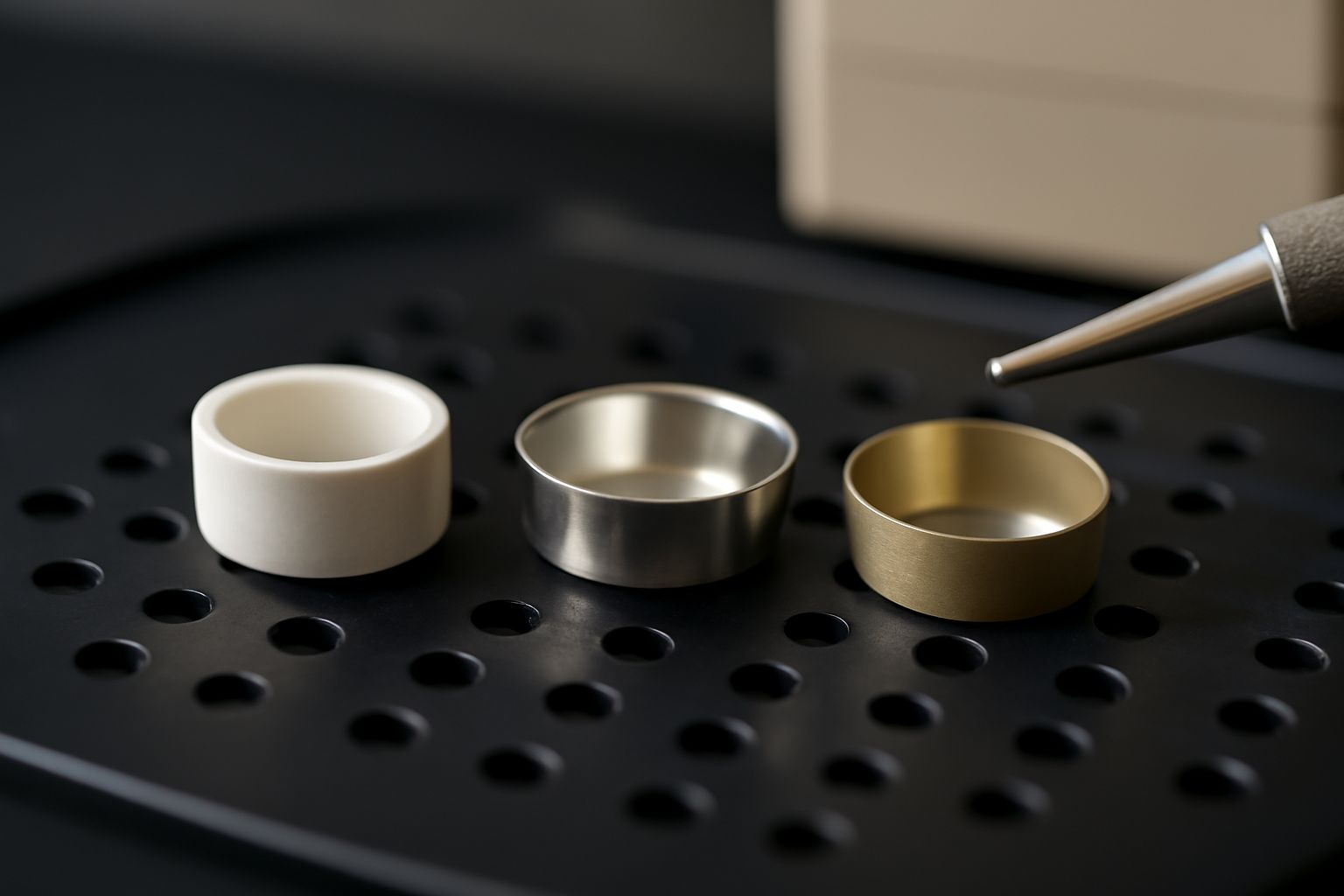
It might look like any pan will “do the job.” But—materials, size precision, and cleaning hold the key to solid results. NSF tolerances, surface finish, and repeated use can all shift your baseline or kill measurement sensitivity. Let’s break down every must-know technical spec to make your purchasing decisions clear and simple.
Poor DSC pans can turn neat signals into noisy lines, all due to size errors invisible to the eye.
Most DSC pans must meet ±0.01mm dimensional tolerances to fit sample holders snugly and avoid heat transfer errors.
| Parameter | Standard Value | Impact on Measurement |
|---|---|---|
| Diameter Tolerance | ±0.01 mm | Improves pan-to-holder contact, keeps thermal resistance low |
| Height Tolerance | ±0.01 mm | Reduces risk of uneven sample coverage; stabilizes heat flow baseline |
| Weight Consistency | ±0.1 mg | Prevents false endotherms/exotherms and baseline offsets |
It may surprise you how even very slight tolerance issues can worsen thermal lag or baseline slope in DSC. In my own experience, switching from generic pans to those with tight quality control improved the repeatability of melting point measurements. Dimensional precision isn’t only a “nice to have”—it keeps the thermal interface stable and your results accurate.
If your pan material isn’t right, you may see poor sensitivity or noisy signals as soon as the run starts.
Material purity and heat conductivity drive baseline stability, sensitivity, and usable temperature range for DSC pans.
| Material | Purity (%) | Max Temperature (°C) | Pros | Cons |
|---|---|---|---|---|
| Aluminum | >99.9 | 650 | Affordable, strong baseline, easy to seal | Oxidizes above 600°C, single-use preferred |
| Platinum | ~99.95 | 1700 | Chemically inert, durable, ideal for repeated use, wide temp range | Expensive |
| Ceramic (Alumina/Zirconia) | >99.8 | 1400–1700 | Stable, reusable, high purity, suited for special samples | Not for all samples, trickier to seal, brittle |
Pans made from highly pure materials create a smoother baseline and steadier sensitivity during DSC runs. For instance, a high-purity alumina pan resists contamination at elevated temperatures, which makes it ideal for research in material science. But with platinum, repeated heating cycles won’t degrade the surface, so my lab usually keeps these reserved for sensitive or expensive sample runs. Your choice makes a real difference in both reproducibility and usable data range.
Reusable pans sound economical, but improper cleaning wears them out—and dirty surfaces ruin your signals fast.
Aluminum pans are usually single-use; ceramics and platinum can be cleaned and reused—but must resist warping and residue after repeated cycles.
| Type | Cleaning Method | Max Reuse Cycles | Risks/Limitations |
|---|---|---|---|
| Aluminum (single-use) | Dispose after use | 1 | Soft, deforms after heating; residue can’t be fully removed |
| Ceramic (reusable) | Thermal cleaning; mild solvents | 10–30+ | Brittle; can chip if mishandled; must check for fine cracks each cycle |
| Platinum (reusable) | Thermal cleaning; acid wash | 50–100+ | Expensive; scratches collect contaminants over time |
Frequent cleaning with aggressive chemicals, or repeated high-temperature runs, eventually damages any pan, especially if the surface finish degrades. From my work in university labs, we track the number of cycles for every platinum or ceramic pan because a warped or scratched pan will drift the baseline, producing unusable readings. Always review the state of the pan carefully between runs—otherwise, one small oversight can upset dozens of measurements.
The wrong pans give unstable baselines, clipping your peaks or adding fake transitions that never really exist.
Pan properties—including size, mass, surface polish, and purity—directly affect calibration, baseline flatness, and the reliability of thermal transitions in DSC.
| Pan Feature | Influence on Data | Critical for… |
|---|---|---|
| Material Purity | Lowers background noise, sharpens transitions, prevents unexpected reactions | Detecting weak/endothermic transitions; research samples |
| Surface Finish | Reduces baseline drift; avoids “ghost signals” from stuck residue | Long series of runs, repeated sample types |
| Pan Thickness & Mass | Regulates heating rate and response time | High-resolution or fast-scanning experiments |
When I checked calibration curves in my previous analyses, pans low in purity often gave noisy signals and shifting baselines. Even minor scratches trapped sample crumbs, generating false peaks in later runs. In precision tests, the pan’s construction was almost as important as the DSC’s own electronics. Do not underestimate these small details—they can influence your experiment results more than you might expect.


C082.Wangdefu International Building, Furong, Changsha, Hunan, China


+86-19907415020