



SHOPPING CART
Your cart is empty.
shop now
Your cart is empty.
shop now
If you want your DSC experiments to work well, you need to pick the right crucible material. Poor choices can cause big errors in test results.
A DSC crucible material must deliver stable heat transfer, resist reacting with samples, and handle the needed temperature range. Good thermal conductivity, chemical resistance, and purity are essential for accurate differential scanning calorimetry readings.
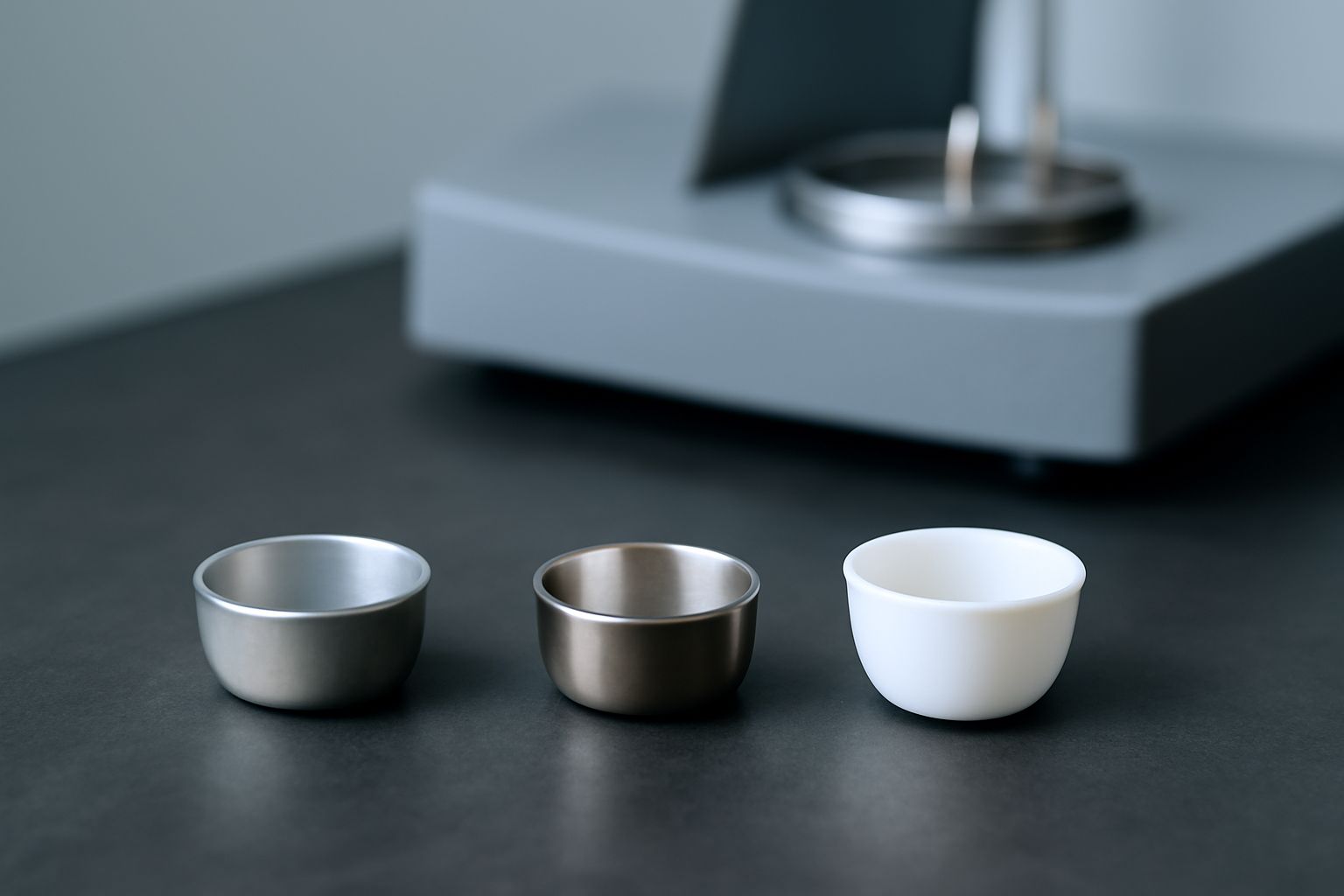
Material properties sit at the heart of DSC crucible performance. This means you have to look at heat flow, sample safety, and temperature limits. By understanding the technical demands, I make better decisions when choosing DSC pans and avoid costly mistakes.
Heat flow in DSC is all about precision. A material with the wrong heat capacity can mask your sample’s data or make small phase changes disappear.
The material heat capacity influences how much energy is absorbed before a temperature change shows up in the DSC. Low heat capacity helps the device react fast, while high capacity can slow or hide small thermal events.
| Material | Typical Heat Capacity (J/g·K) | Effect on DSC Analysis |
|---|---|---|
| Aluminum | ~0.90 | Fast reaction, low background; ideal for most thermal analysis uses (aluminum info) |
| Platinum | ~0.13 | Very stable signal, almost fully inert; used for sensitive or high-precision work |
| Ceramic | ~1.10–1.50 | High capacity can dampen small peaks; more for special or corrosive samples |
| Gold | ~0.13 | Very low background, outstanding for analytical purity (gold explained) |
I always check the material data sheet to make sure the heat capacity does not mask sensitive results. Peer-reviewed studies show that using low heat capacity pans like platinum or gold can improve measurement sensitivity when testing very low-mass samples or fine transitions. For routine use, high-purity aluminum delivers clean, repeatable performance.
High temperatures will push a DSC crucible material to its limits. Picking the wrong one ends in warped pans or even lost samples.
Materials for DSC crucibles must survive the maximum test temperature without melting or breaking down. Metals like platinum and special ceramics handle the highest ranges. Always match the crucible to your real temperature needs.
| Crucible Material | Max Safe Temperature (°C) | Recommended Application |
|---|---|---|
| Aluminum | 600 | Standard DSC use; good for polymers, pharmaceuticals, food samples |
| Platinum | 1600 | High-temp DSC and STA; ideal for glasses, ceramics, metals |
| Ceramic (Alumina) | 1300–1700 | Oxidative stability, harsh conditions, very high temp (alumina basics) |
| Gold | 1085 | Pharmaceuticals, reactive or corrosive samples, but less cost-effective |
My own lab work often involves high-end glass or alloy samples. In these cases, I need the crucible to perform well above standard aluminum temperatures. Technical manuals and product bulletins from leading suppliers confirm platinum and alumina ceramics are safest for temperatures above 600°C . These materials make it possible to analyze transitions and reactions at much higher ranges.
If a crucible expands too much, it can damage your DSC instrument or release your sample. Close control over material expansion is a must.
Low and predictable thermal expansion in a DSC crucible protects both the sample and the instrument. Metals like platinum and gold stay very stable. Aluminum expands more, but remains controlled within the typical DSC temperature window.
| Material | Thermal Expansion (10⁻⁶/K) | Impact on Stability |
|---|---|---|
| Aluminum | 22–24 | Expands steadily; safe up to rated limit; needs proper lid (thermal expansion info) |
| Platinum | 8.8 | Very stable, does not affect measurement; good for repeat use |
| Ceramic (Alumina) | 6–8 | Minimal expansion, mechanical stability at extreme temps |
| Gold | 14.2 | Moderate; remains reliable for high purity measurements |
In my experience, lower thermal expansion means better repeatability and less wear on the instrument (DSC basics). For routine analysis, I trust aluminum, but for the most sensitive work, platinum and alumina keep results as stable as possible. Manufacturers’ data sheets always reveal expansion rates, making it easy to choose the safest option.


C082.Wangdefu International Building, Furong, Changsha, Hunan, China


+86-19907415020