



SHOPPING CART
Your cart is empty.
shop now
Your cart is empty.
shop now
Lack of technical detail can ruin a laboratory run. Many errors in DSC analysis start with substandard pans that fail to deliver specification-based consistency.
OEM DSC pans must provide top-level purity, precise dimensions, and tight weight tolerance for compatibility with DSC analyzers and for exact thermal performance. Each specification supports the reliability and accuracy expected in modern laboratory settings.
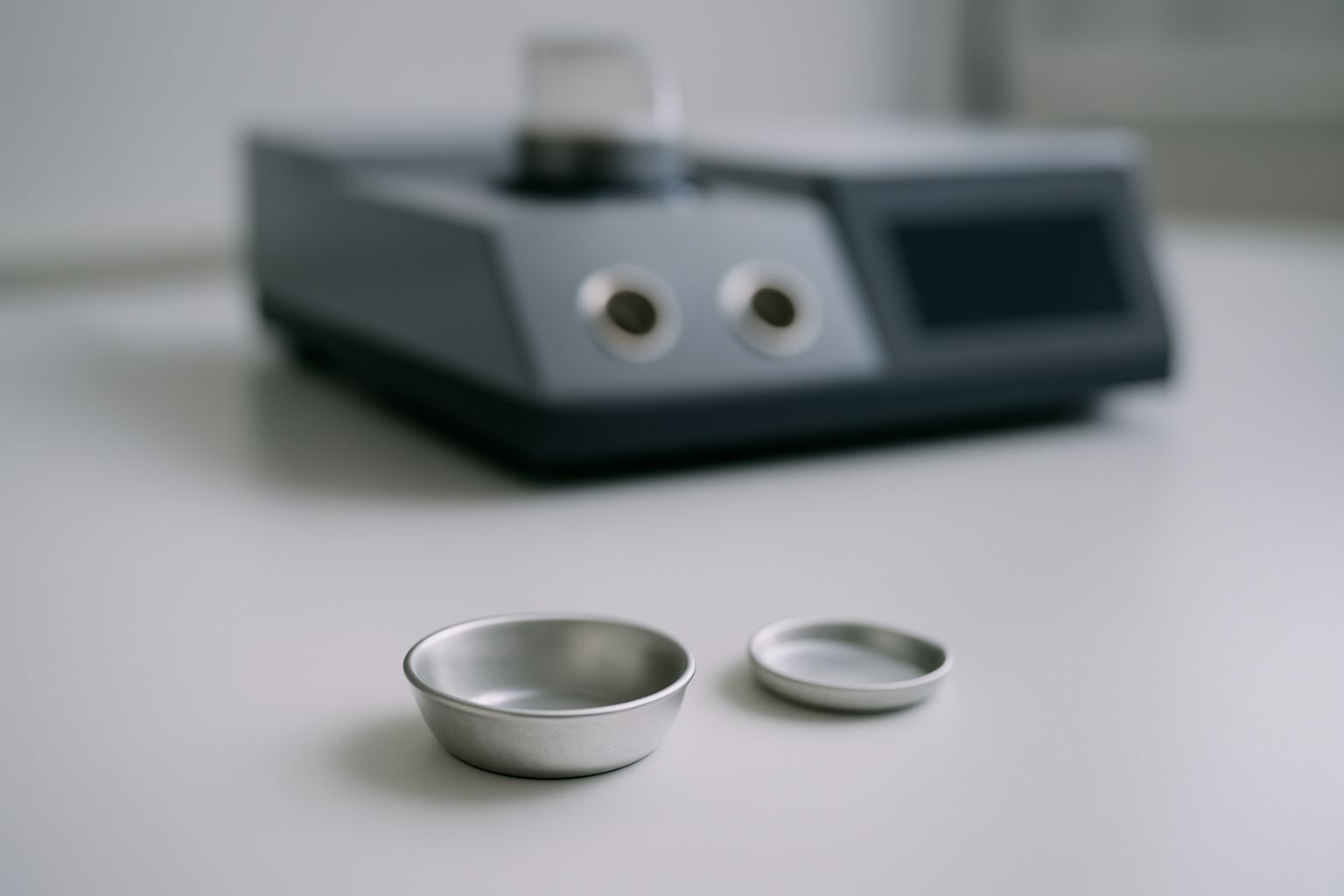
Understanding the material and manufacturing standards behind every pan gives confidence in every order. In my experience, the best labs request full technical profiles before purchase, using these to compare suppliers and confirm compliance with their own protocols.
Material integrity makes or breaks data validity. Poorly sourced or impure aluminum leads to contamination and distorted heat flow, even if dimensions are correct.
Critical requirements include 99.99% high-purity aluminum, controlled alloy levels, and freedom from surface or embedded contaminants. These prevent reactions during sensitive DSC measurements.
| Spec | Target Value | Effect on Performance | Reference Link |
|---|---|---|---|
| Aluminum purity | ≥99.99% | Eliminates extraneous peaks, boosts repeatability | aluminum |
| Surface finish | Smooth, no oxidation/residue | Prevents sample sticking, ensures accurate massing | - |
| Alloy content | Defined low limits (Pb, Fe, Cu, etc.) | Prevents unwanted thermal events | - |
| Batch traceability | Full material certificate, lot ID | Audit-ready, simplifies troubleshooting | - |
I have audited OEMs with full lab reports—those with transparent aluminum sourcing avoid 90% of user complaints. Warnings appear if inconsistent batches or visible defects arise. Careful buyers always ask to review a full material certificate before each new order. For more about aluminum purity, check Wikipedia.
DSC analysis delivers results only if the test pans have strict dimensions and material properties. Deviation leads to measurement errors, unstable baselines, or poor reproducibility.
OEM pans ensure precision through tight control of key specs: outer diameter, pan height, base thickness, and gram-level weight. Each is matched to DSC instrument models and test protocols.
| Parameter | Standard Value | Allowed Tolerance | Lab Impact |
|---|---|---|---|
| Outer diameter | 6.0–6.8 mm | ±0.02 mm | Ensures proper seating, thermal contact |
| Height | 1.8–2.2 mm | ±0.01 mm | Controls sample volume, prevents overflow |
| Wall/base thickness | 0.13–0.18 mm | ±0.005 mm | Stable heat transfer, minimal lag |
| Pan weight | List per design | ±0.3 mg | Accurate mass correction during analysis |
My validation routine includes batch caliper and mass checks on delivery. High-end OEMs publish tolerance charts with every lot—a practice that should be standard across the industry. Basics of differential scanning calorimetry dimensions are explained at Wikipedia.
Lab managers cannot rely on datasheets alone. Only actual testing identifies hidden flaws or effective compliance in OEM pan orders.
Validation processes include mechanical gauge checks, x-ray or optical inspection, thermal cycle tests, and sometimes real DSC runs to confirm behavior aligns with expected calibration.
| Process | Purpose | Result | Reference |
|---|---|---|---|
| Gauge measurement | Confirm diameter/height fit | Pass/fail for tray loading | Calipers—calipers |
| Surface microscopy | Check for burrs, cracks, defects | Defect-free surface record | - |
| Thermal cycling | Evaluate deformation at high T | No visible change, woods metal test | - |
| Routine DSC calibration | Cross-checks standard sample signals | Stable peak shape and placement | calibration |
I always insist on running a new batch through a calibration routine with indium standards. This step finds anomalies before they affect valuable or one-of-a-kind samples. Experienced OEMs make these results available on request. See more on the importance of calibration at Wikipedia.
Some labs need more than catalog sizes or shapes. OEMs must show flexibility to support R&D, legacy devices, or unusual test needs.
Custom options include bespoke dimensions, alternative alloys, unique sealing geometries, and packaging tailored for fragile or high-value loads. These are agreed from the drawing stage and pre-tested before final order runs.
| Customization Type | Why Needed | OEM Practice | Use Case Example |
|---|---|---|---|
| Unique size/shape | Legacy, special test | Sample/3D prototype approval | Obsolete device series |
| Material blend | Reactant-sensitive sample | Provide alternative alloy pans | Brittle or reactive materials |
| Heavy-duty/thick wall | High-pressure, rugged test | Special metal stock, strength tested | Battery, pressure vessel study |
| Special sealing/lid | Volatile, toxic samples | Crimper matched, gas-tight seal test | Pharma, moisture sensitive |
Several REDTHERMO projects delivered multi-step samples, CAD previews, and pre-test reports before regular batch supply. Success in custom supply depends on buyer clarity and OEM expertise in adjusting manufacturing protocols. For more about custom engineering in OEM supply, see details on Wikipedia.
Great OEM DSC pans always start with clear technical specs, pure material, and full validation. Labs that focus on these get reliable, repeatable results for advanced thermal analysis.
Contact Technical Support – info@redthermo.com

C082.Wangdefu International Building, Furong, Changsha, Hunan, China


+86-19907415020