



SHOPPING CART
Your cart is empty.
shop now
Your cart is empty.
shop now
Lab professionals know that even minor flaws in DSC pans cause big headaches for experiments. Overlooking technical details can lead to incorrect data and wasted material.
Disposable aluminum DSC pans deliver reliable results when they have the right thickness and are made of high-grade aluminum. Their technical specifications, including composition and design, play a direct role in thermal analysis quality.
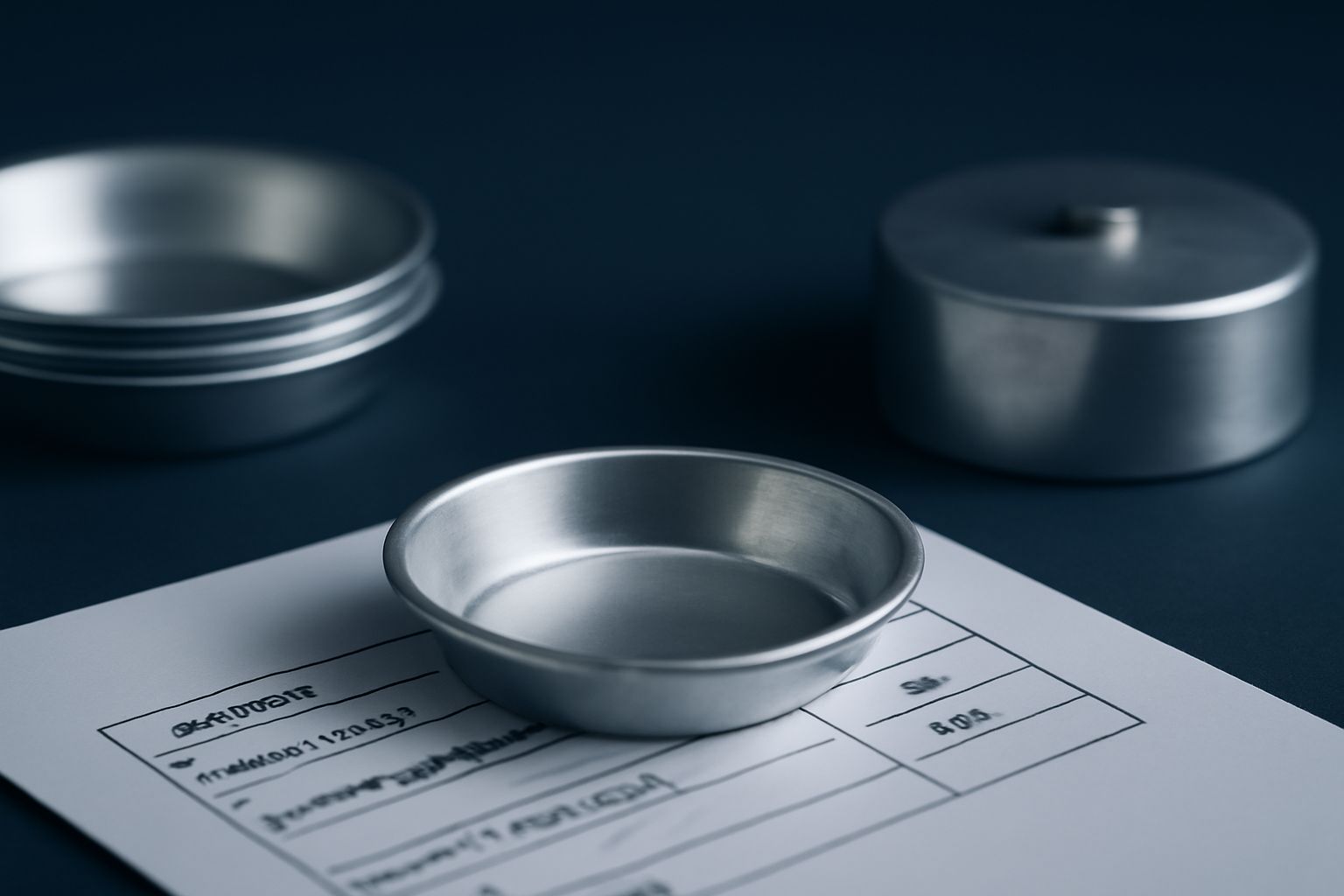
Technical details make or break DSC performance. I focus on pan properties and vendor documentation before every order to ensure my temperature curves are always accurate. Here’s how the details matter most.
Material selection has a big impact on DSC test reliability and ease of use. Poor choices may cause contamination or imprecise heat transfer in your data.
Aluminum is widely used for DSC pans due to its high thermal conductivity, low cost, resistance to oxidation, and ability to withstand the temperatures required for thermal analysis. Its robust nature allows clear and clean heat flow readings.
| Attribute | Aluminum Value | DSC Benefit |
|---|---|---|
| Thermal Conductivity | ~235 W/m·K | Accurate and even sample heating |
| Melting Point | 660°C | Safe below TGA/DSC test temps |
| Chemical Reactivity | Resists corrosion from air and moisture | Long storage stability |
| Cost | Cheap raw material (aluminum info) | Affordable routine use |
| Mass | Low | Works with precision balances |
I have tested multiple metals, but always return to certified aluminum pans for routine testing. Reliable performance and low reactivity ensure reproducible DSC data, supported by general consensus in the ASTM E928 standard.
Pan geometry determines sample stability, heating uniformity, and resolution of thermal events. Overlooking design features can introduce large errors in recorded data.
The right DSC pan design balances wall thickness, surface area, and pan depth to maximize heat transfer and sample uniformity. Poor design may cause hotspots, inconsistent melting points, or baseline drift during measurement runs.
| Design Feature | Effect in Test | Data Outcome |
|---|---|---|
| Wall Thickness | Controls heating rate | Stable, repeatable peaks |
| Base Flatness | Ensures maximum thermal contact | Minimizes baseline drift |
| Capacity | 5–50 ul for flexible sample sizes | Enables method adjustments |
| Pan Height | Supports correct sample loading | Reduces overflow risk |
| Lid System | Crimped or snap-fit (seal info) | Prevents evaporation loss |
My lab’s QC process includes baseline tests for each new batch of pans. I check for uniform peaks and heating to ensure no change will affect data consistency across research projects.
Incorrect or subpar pans lead to contamination, sample loss, or equipment damage. Knowing the physical and chemical data helps guarantee lab safety and success.
Good disposable pans are defined by their purity, consistent wall structure, and surface finish. The aluminum used should be at least 99.7% pure, crack-free, and free of oil or particulate residue after production.
| Property | Typical Range | Implication in Use |
|---|---|---|
| Purity | 99.7%–99.99% | Reduces contamination risk |
| Surface Finish | Polished, no debris | Accurate sample weighing |
| Shape Tolerance | ±0.02 mm diameter | Consistent fit in DSC instruments |
| Thermal Expansion | 22–24 x 10^-6/K | Stable across common cycles |
| Odor or Residue | None detected | Safe for all sample types |
I always ask vendors for batch certificates and inspect pans under magnification for flaws. Major suppliers reference chemical and dimensional standards in line with ISO 17025 quality systems.
Many errors in DSC are caused by uneven heating and peak shifts. Pan thickness is a direct influence on heat distribution and technical accuracy.
Uniform pan thickness, typically 0.12–0.2 mm, is essential for stable heat transfer and sharp baseline in DSC output. Thin pans may warp or create hotspots, while thick pans slow response and distort test curves.
| Thickness (mm) | Heat Effect | Measurement Quality |
|---|---|---|
| 0.10–0.12 | Very fast heating, risk of warping | Possible errors at high temp |
| 0.13–0.16 | Optimal, even heat transfer | Best for routine DSC measurements |
| 0.17–0.20 | Slower to heat, stable at high temp | Use for long or high energy cycles |
| Over 0.20 | Delays signal response | Not preferred unless special |
| Under 0.10 | Easy to deform, risk of leaks | Should be avoided in routine work (thermal conductivity) |
I use calipers to check pan thickness in every batch. Labs targeting reliable, transferable results should always verify both spec sheets and real dimensions for new pan shipments—even when buying from trusted suppliers.


C082.Wangdefu International Building, Furong, Changsha, Hunan, China


+86-19907415020