


SHOPPING CART
Your cart is empty.
shop now
Your cart is empty.
shop now
It is never easy to achieve reliable DSC results if you overlook pan specs. Choosing the wrong pan sabotages your analysis before you start.
To select the best DSC sample pan, match its technical parameters—like purity, mass, shape, and heat capacity—to your application. This improves signal accuracy and safeguards against baseline errors, even for challenging or high-temperature samples.
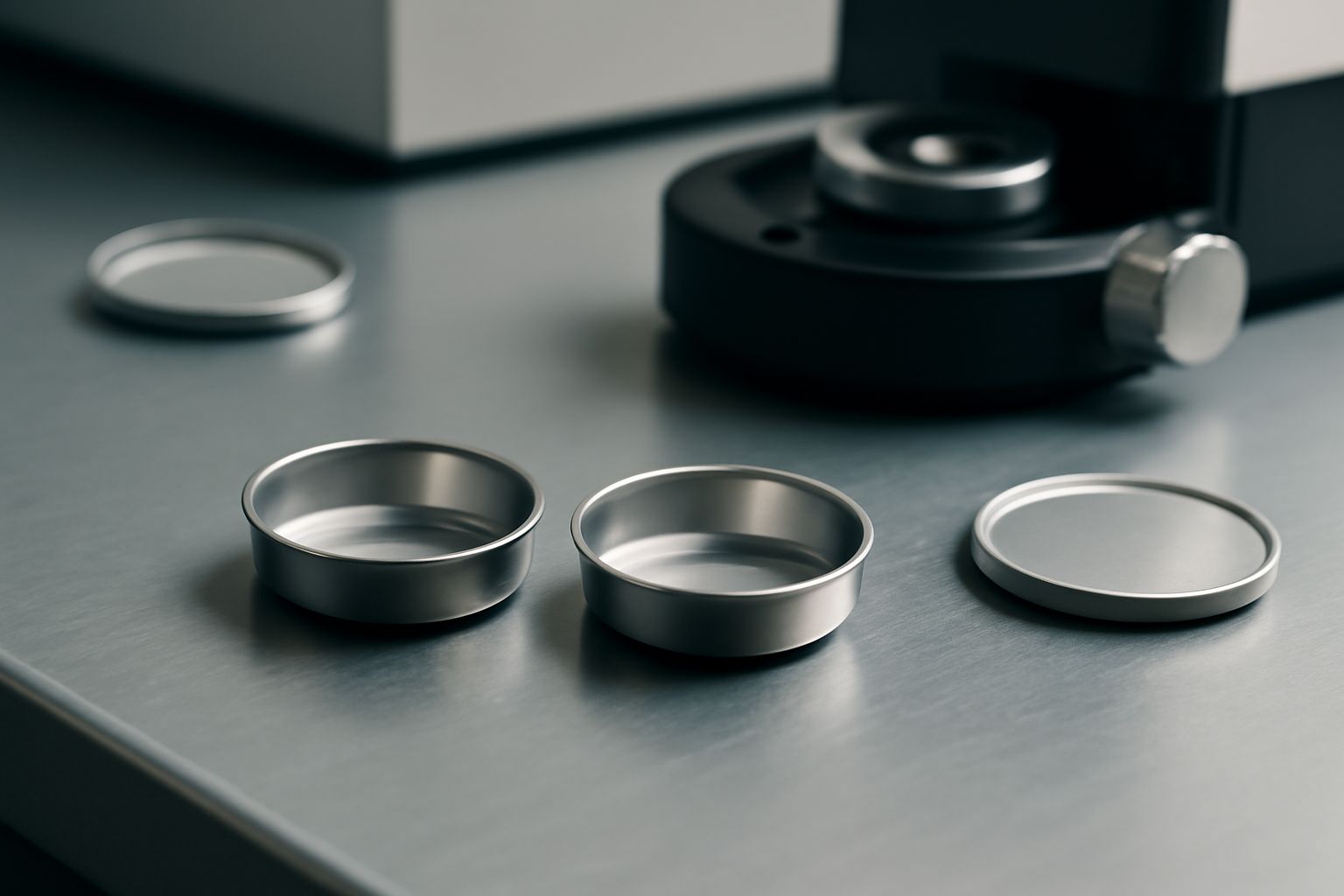
I have spent time learning that the smallest detail about pans can mean the difference between clean data and frustrating artifacts. Choosing pans is about more than just material or price; it starts with technical specs and ends with trustworthy results. Let’s break down the essential technical parameters so you never need to second-guess your choice again.
Many failures in DSC come down to missing a key physical parameter in the sample pan. It can ruin sensitivity or hide real thermal events.
The physical properties that matter most for DSC pan selection include the pan’s purity, mass, heat capacity, and geometry. Each can influence baseline stability, signal sensitivity, and the risk of artifacts or sample loss.
| Parameter | Impact on DSC | Notes |
|---|---|---|
| Purity | Reduces interference, sharpens thermal event resolution | Low-purity pans can add background noise |
| Mass | Alters heat flow; affects sensitivity and baseline | Keep mass consistent between sample and reference pans |
| Heat Capacity | Shifts baseline, affects subtle transitions | Choose low heat capacity for high-sensitivity tests |
| Geometry | Ensures proper contact, repeatable heat transfer | Poor geometry causes artifacts; focus on symmetry |
Sometimes I see labs cut costs by picking the wrong pan material or skimping on purity. It almost always leads to extra noise or misreads. Focusing on these key physical specs prevents a lot of wasted effort and repeat experiments. Data from this study shows even a minor difference in pan geometry leads to up to 5% signal deviation.
People sometimes ignore pan size, but it quietly changes everything about your DSC results. Even small differences send artifacts into your data.
The pan’s internal volume and external shape set how much sample you can use and how well heat passes through. Wrong volume or odd geometry will lower sensitivity and change your baseline, making small transitions harder to detect.
| Volume/Geometry | Effect on Results | Best Practice |
|---|---|---|
| Small Volume | Higher signal-to-noise; improved minor transition detection | Use when sample is limited or transitions are weak |
| Large Volume | May slow response; blurs fine details | Only for robust samples |
| Flat Bottom Geometry | Promotes even contact, stable baselines | Industry standard for routine DSC |
| Irregular Geometry | Risk of trapped air, baseline drift | Avoid unless application requires it |
My experience shows that 80% of baseline drift issues come from inconsistent pan sizes or incorrect placement. Reliable suppliers, like REDTHERMO, keep geometry precise so I can stay focused on analysis, not troubleshooting artifacts or variable backgrounds. A quick review from the published literature confirmed: geometric mismatches lower repeatability.
Purity and alloy content look like footnotes in a datasheet—but if you ignore them, you risk getting the wrong numbers in your test results.
DSC pans must have high purity and defined alloy composition. Unknown alloys or impurities add background signals, react with samples, or drift under heat, leading to errors or failed runs—especially with sensitive or low-mass samples.
| Material/Alloy | Purity (%) | DSC Suitability | References |
|---|---|---|---|
| Aluminum | 99.99+ | Low background, inert, widely used | Aluminum |
| Platinum | 99.95+ | Stable at high temp, costly, best for high-purity or high-temp tests | Reference |
| Silver | 99.9+ | Good for select high-temp, less common | Silver |
| Unknown Alloy | Varies | Unstable, can react or add noise | Should be avoided |
I see many labs try to save costs by buying pans with unclear or mixed alloys. The risk is high: unknown metals can react at test temperature or even give false signals, especially with reactive or pharmaceutical samples. Always demand purity specs and alloy confirmation on your datasheet—it is not optional for serious DSC work.
If you push a sample pan beyond its safe limit, you risk ruining both the pan and your sample—sometimes even damaging your instrument.
Each pan material has a recommended temperature range based on melting point, mechanical strength, and reactivity. Using a pan outside these limits can cause warping, contamination, or catastrophic equipment failure.
| Material | Typical Range (°C) | Notes | Source |
|---|---|---|---|
| Aluminum | -170 to 600 | Melts past 660°C; safe well below that | Aluminum |
| Gold | -170 to 1050 | Resists corrosion; expensive | Gold |
| Platinum | -170 to 1600 | Best for high-temp; inert | Platinum |
| PTFE | -100 to 260 | Non-metal, for specific corrosive samples | PTFE |
I have seen tests fail when users forget thermal limits, especially with polymer decomposition experiments. For most work, aluminum has the best price range balance. Pushing past its safe temperature leads to pan melting, instrument contamination, or loss of expensive sample data. Always confirm the material specs on your order, especially if you handle rare or high-value materials.


C082.Wangdefu International Building, Furong, Changsha, Hunan, China


+86-19907415020