


SHOPPING CART
Your cart is empty.
shop now
Your cart is empty.
shop now
Getting reliable DSC data can seem hard when you first start. Worries about inconsistent results or wasted effort are real for any new user.
DSC crucibles have set technical standards: strict dimensions, precise tolerances, and clean material specs. Beginners should check these details when choosing, because they avoid common pitfalls and improve experiment precision.
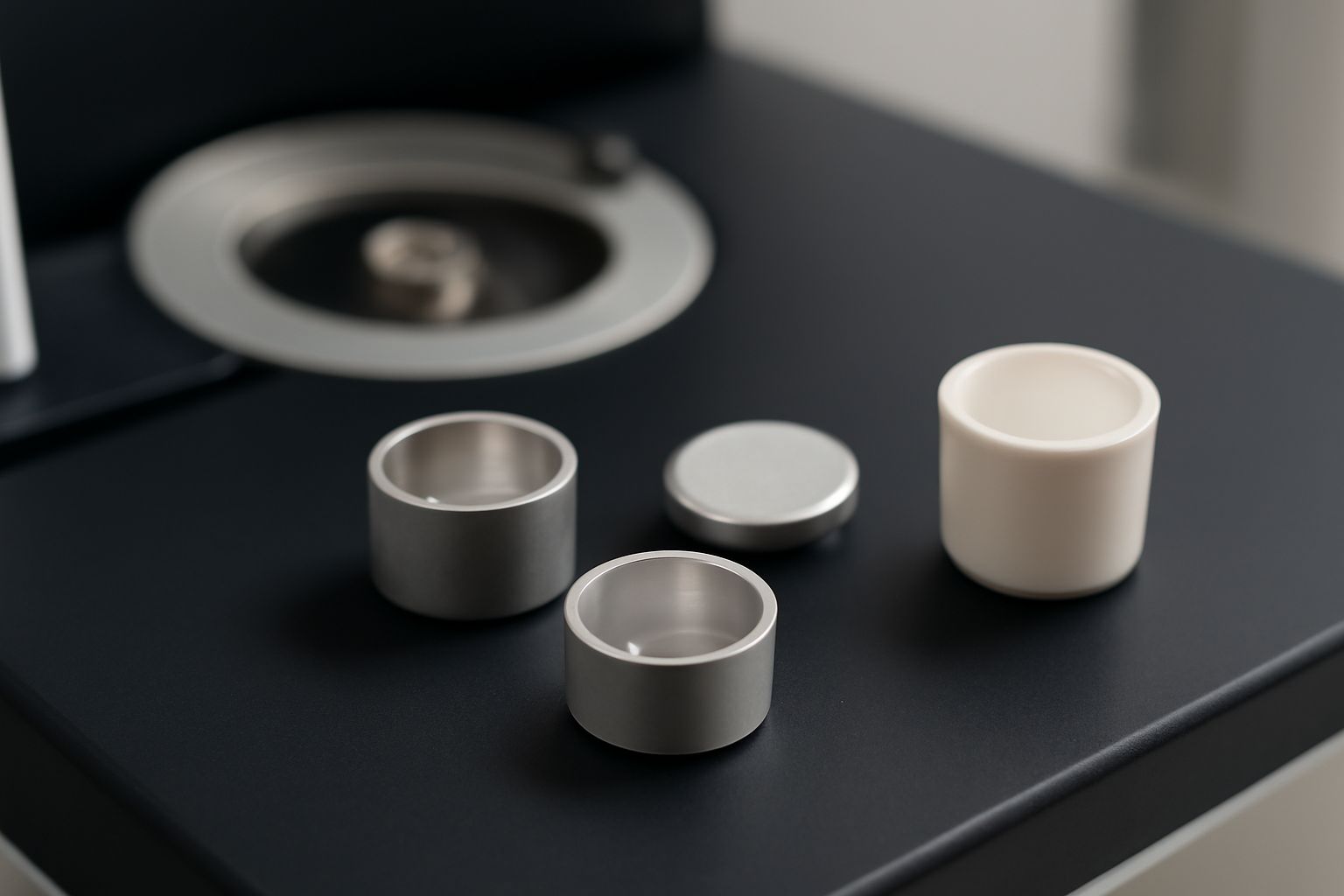
Crucible design is more complex than it looks. If I first picked just by price or brand, my early results were rarely smooth. Paying attention to real specifications now saves me time, money, and repairs. Next, I’ll break down the vital tech data you need for smart decisions — even if you’re new.
Choosing crucibles blindly risks data errors and leaks. Even minor dimensional errors can ruin your whole analysis and waste scarce samples.
Standard DSC crucibles follow strict sizes—commonly 6 mm to 8 mm diameter, height 2 mm to 4 mm, and a tolerance as tight as ±0.01 mm. For common brands like METTLER or TA Instruments, always match both diameter and height. Strict tolerances ensure your pan fits snug, heats evenly, and won’t jam.
| Brand | Diameter (mm) | Height (mm) | Tolerance (mm) | Application Notes |
|---|---|---|---|---|
| METTLER | 6.7 ±0.01 | 2.8 ±0.01 | ±0.01 | Fit for Mettler DSC 1 / 2 systems |
| TA Instruments | 6.0 ±0.02 | 2.0 ±0.02 | ±0.02 | DSC Q-Series, typical fitting |
| PerkinElmer | 6.4 ±0.01 | 2.6 ±0.01 | ±0.01 | Pyris DSC; watch for slight design changes |
| Tolerance | Defined as the permissible limit of variation. In DSC, usually less than ±0.01 mm. | |||
When I started out, I learned that even a tiny size mismatch made my crucibles jam or leak. That caused baseline shifts, ruined samples, or even expensive sensor damage. Always check specs from both your DSC manufacturer and crucible maker before buying new pans. Pick suppliers who show specs, not just pictures.
New users often don’t know which material suits their experiment. Choosing the wrong pan can cause chemical reactions or contaminate your sample.
Aluminum, platinum, and high-purity ceramics are the main materials in DSC crucibles. Aluminum fits routine work with organics; ceramic and platinum suit more harsh conditions or high-heat work. Different materials change melting points, sample stability, and background signals.
| Material | Main Properties | Temperature Range | Common Use |
|---|---|---|---|
| Aluminum | Good heat transfer, reacts with some chemicals | -180°C to 600°C | Polymers, organics |
| Ceramics | Stable, high-purity, non-reactive | -180°C to 1500°C | Oxidizing atmospheres, high-temp inorganics |
| Platinum | Excellent stability, inert | -180°C to 1700°C | Extreme heat, high-purity samples |
| Gold, Sapphire | Rare, special cases only | Varies by property | Ultra-pure apps |
Once, I used a cheap generic pan that was not pure aluminum. My thermogram was noisy, and my thermal peaks seemed to jump. When I changed to verified high-purity aluminum, the peaks stabilized. From then on, I always checked material spec—often shown on technical data sheets for each supplier. For typical work, stick to aluminum unless your sample needs special care or very high temperature, and always look for the material grade code.
DSC can be misleading if pan contamination or rough surfaces cause random heat flow. Beginner mistakes often come from low-purity or poorly polished pans.
Material purity above 99.9% gives steady baseline signals. Smooth finishes avoid sample sticking and heat traps. These directly shape the accuracy and repeatability of DSC data for sensitive samples.
| Pure Crucible Grade | Impurity Level | Surface Finish Typical (Ra) | Impact on DSC Data |
|---|---|---|---|
| High-purity Aluminum (99.99%) | <0.01% | <0.2 μm | Best signal, no extra peaks or noise |
| Standard Ceramics | <0.1% | <0.5 μm | Stable, especially for baseline |
| Low-purity Pan | >0.5% | >1.0 μm | Baseline drift, broad or missing peaks |
| Surface Finish | Measured by Ra: lower is smoother, better for DSC. | ||
I remember one case where my baseline shifted by 0.2 mW just by swapping to a lower-grade supplier. Once I examined the pan with a magnifier and compared the surface roughness, it was clear: rougher pans trap small pieces that heat at random. Always check for both purity and polish on supplier spec sheets. In most cases, a smooth, polished surface and clear purity mark will give the most stable DSC baseline and repeatable results. Rely on official certificates and ISO if available.
Choosing wrong temperature rating risks warped pans and burned samples. Picking the wrong volume means weak signals or overflows.
Match your sample’s working temperature to the pan’s max rating, and fill pans so samples cover the bottom thinly (typically 10–60 μL). Picking pans beyond your max heat point ensures safety and gives reliable signals.
| Crucible Type | Recommended Temp (°C) | Max Temp (°C) | Usual Volume Range (μL) | Best Application |
|---|---|---|---|---|
| Aluminum | -180–450 | 600 | 20–40 | Standard DSC, low-mid temp |
| Ceramic | -180–1200 | 1500 | 30–50 | Thermal events, high-temp study |
| Platinum | -180–1000 | 1700 | 10–60 | Extreme heat, pure samples |
| Microliter | Unit used for small sample volume in chemical analysis. | |||
For my regular work with polymers, I stick to open aluminum pans, filling them with about 30 μL. If you plan thermal decomposition studies or exotic inorganics, always check both temperature and compatibility in the supplier’s data. A pan that’s just 10°C beyond your process can start to deform or crack. And always respect sample load: too much causes overflow, too little makes peaks hard to see. Reliable suppliers list both max temperature and safe volume on every spec sheet.
Master DSC crucible specs from the start. Focus on matching dimensions, pure materials, and application ranges to make your analyses accurate and stress-free.


C082.Wangdefu International Building, Furong, Changsha, Hunan, China


+86-19907415020