



SHOPPING CART
Your cart is empty.
shop now
Your cart is empty.
shop now
Every step in materials research thermal testing matters. The sample container you select can either support your data accuracy or introduce unwanted errors in your differential thermal analysis.
Sample containers play a critical role in materials research and thermal testing. The right container ensures controlled heat flow, prevents contamination, and delivers the precise results required for reliable DTA experiments.
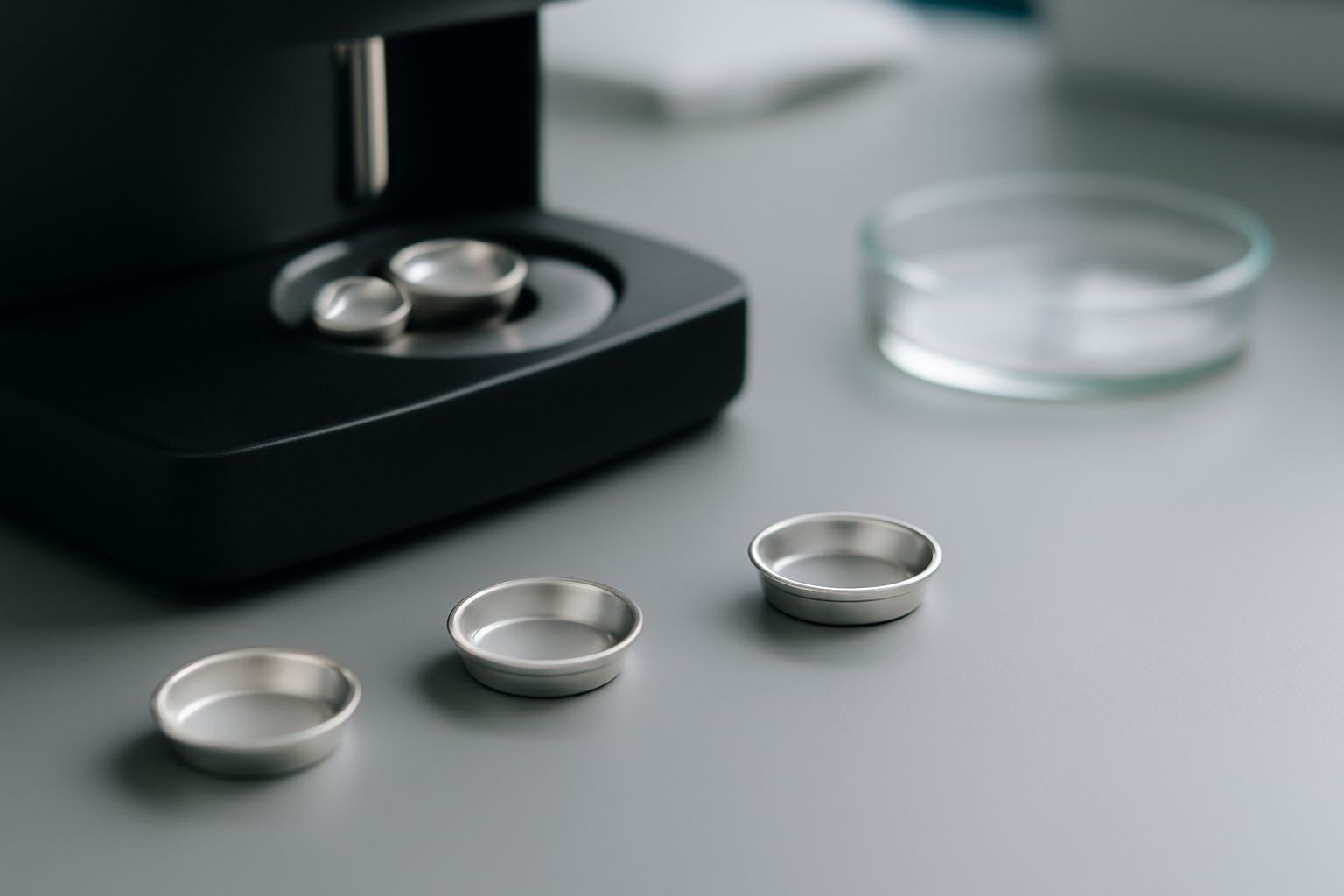
I have worked in labs where small changes in the container made huge differences in DTA interpretation. The best results consistently come from selecting format, material, and fit that match each research need.
Accurate heat flow measurement in DTA requires sample holders with the right geometry and thermal properties. Tiny deviations in design or cleanliness can cause big mistakes in test outcomes.
Sample containers improve accuracy by delivering uniform heating, minimizing sample loss, and preventing cross-contamination. They fit exactly into the DTA instrument, ensuring each reading reflects only the sample, not an interaction with the container (Differential Thermal Analysis).
| Factor | Impact on Accuracy | Example | Lab Practice |
|---|---|---|---|
| Uniform wall thickness | Even temperature distribution | Melting point study | Pan quality inspection |
| High purity | Reduces contamination | Polymer test | Aluminum/platinum containers |
| Precise volume | Consistent measurements | Repeatability check | Weigh before each run |
| Tight fit | Minimal movement means accurate signals | Aggressive heating cycles | OEM-matched containers |
Material compatibility is vital. Using the wrong container exposes the sample to risk of chemical reactions, poor thermal contact, or even equipment damage in high-precision research.
High-precision DTA prefers platinum for its inertness and broad heat capability, and high-purity aluminum for cost-sensitive work. Advanced ceramics are best for strong acids or unique compounds. The chosen material must match both sample chemistry and required analysis range (platinum).
| Material | Thermal Range (°C) | Best Use | Advantages | Limitations |
|---|---|---|---|---|
| Platinum | Up to 1600 | High-temp, inert tests | No reaction, long life | Expensive |
| Aluminum | Up to 630 | Routine organic | Affordable, good heat | Limited temp, risk of melt |
| Ceramic | Up to 1750 | Aggressive/acid sample | Resists reaction | Brittle, less flexible |
Container selection directly influences reproducibility, peak definition, and background stability. Picking poorly matched pans can distort DTA curves and lead to failed science conclusions.
Well-chosen containers maintain sample mass, enable correct baseline subtraction, and make cleaning easier between runs. Their high tolerance fits also help multi-user labs achieve consistent readings on complex samples (thermal analysis).
| Selection Factor | Error Prevented | Benefit | Lab Scenario |
|---|---|---|---|
| Matching instrument specs | Incorrect heat transfer | Cleaner signal | Multi-unit research |
| Surface cleanliness | Contamination | Stable baseline | Shared equipment labs |
| Batch tracking | Variation in geometry | Result repeatability | Long-term projects |
| Material choice | Chemical reactions | Pure transitions | Phase change test |
Special samples and new tests sometimes need more than a standard pan off the shelf. Custom containers give research labs precision and control for new material challenges.
Custom holders match rare shapes, size, or chemistry, supporting exact placement and zero leaks. Engineers can order these directly from suppliers using sample or drawing and receive a container for higher reproducibility and unique experimental design (customization).
| Custom Feature | Why Useful | Outcome | Research Example |
|---|---|---|---|
| Custom geometry | Odd samples, exact fit | No shifting, stable baseline | Aerospace composite test |
| Material hybrid | Dual-phase needs | No reaction | Multi-phase alloy R&D |
| Special seals | High-volatility | No evaporation | Battery cell study |
| Micro-volume pans | Rare/expensive samples | Less material used | Medical polymer dev |


C082.Wangdefu International Building, Furong, Changsha, Hunan, China


+86-19907415020