



SHOPPING CART
Your cart is empty.
shop now
Your cart is empty.
shop now
Unexpected errors and unreliable results can frustrate anyone doing DSC tests. The right sample pans will help avoid equipment issues and wasted time in the lab.
Common DSC testing problems are often solved by choosing compatible pans and using them the right way. Always ensure each pan matches your DSC instrument, check the design, and store pans to maintain accuracy.
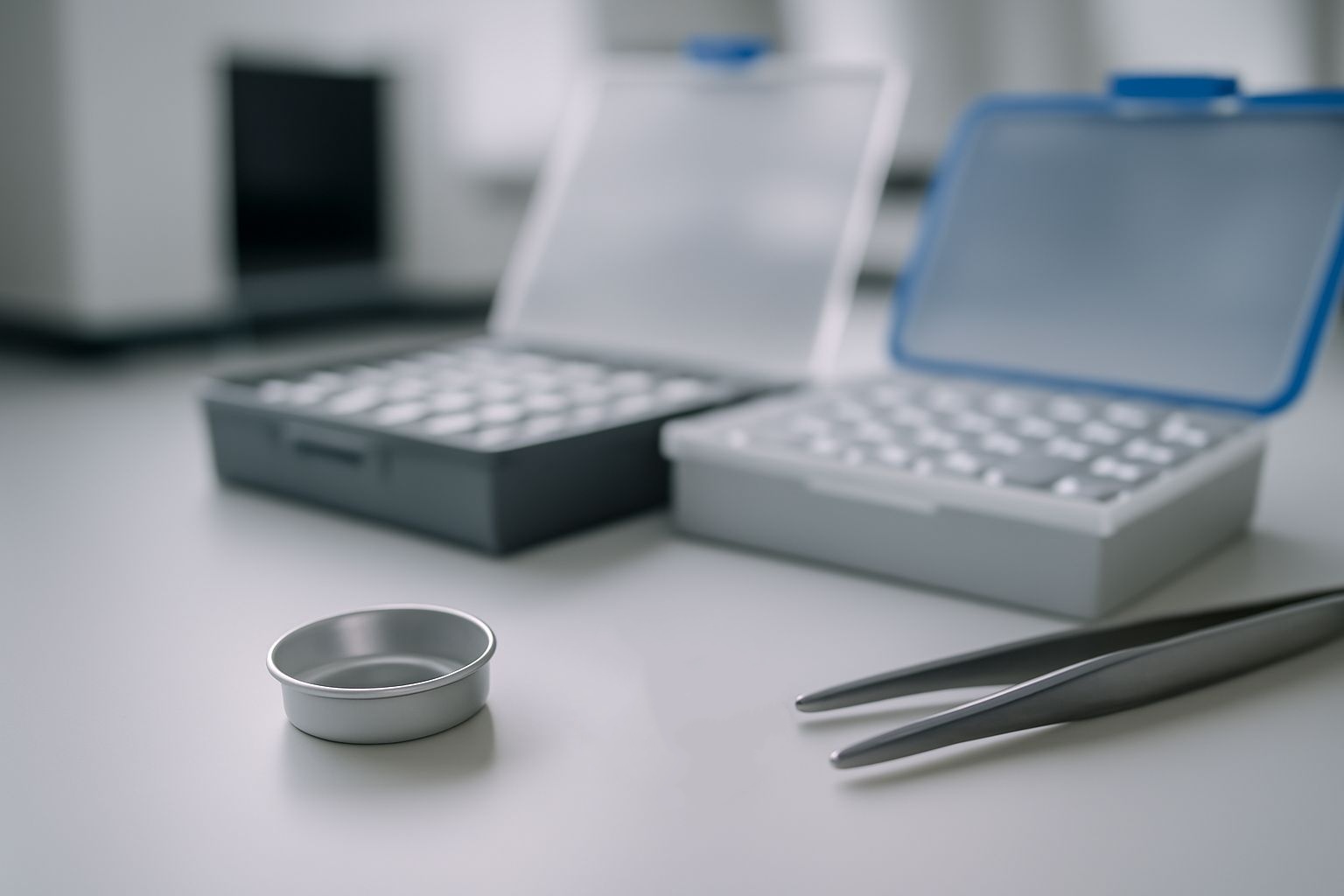
Once, I struggled for weeks with inconsistent results, only to find my pans were not fully compatible with my equipment. By learning the details of pan design, heating, and storage, I now get much more repeatable results. Let’s look at each important part.
DSC experiments might fail without warning if your pan does not fit. Compatibility issues often cause leaks, baseline shifts, or device alarms.
DSC pans must precisely match your equipment’s brand and model. Using mismatched pans can lead to poor thermal contact, faulty calibration, or system errors during testing.
When I used generic pans without checking their compatibility, my instrument readings became unstable. Major brands like TA Instruments and METTLER require pans with exact diameter and lid types. I always compare the model codes and request a technical drawing before I buy. Even small differences can block the heater or sensor. Using poorly matched pans has triggered software errors, so I stick with suppliers who clearly list which lab equipment each pan fits. The table below lists common compatibility problems and how to solve them:
| Compatibility Issue | Cause | Solution |
|---|---|---|
| Leaking Pan | Incorrect lid or diameter | Verify specs with supplier |
| Baseline Drift | Poor fit or wrong material | Choose OEM-compatible pan |
| Device Alarm | Wrong pan height or type | Check equipment manual |
| Slow Response | Loose thermal contact | Use pans made for your model |
Knowing about interchangeable parts made it easier to understand why every detail matters for smooth DSC operation.
Small changes in pan shape or material can shift your measured heat flow. Results may become variable or unreliable if you do not match the right design to your test.
The design affects the pan’s thermal contact, heating rate, and sealing. Choose the best shape and material to fit your sample type and measurement goals.
I noticed that shallow pans heat up faster, and pans with shiny finishes reflect more energy. For tests involving moisture or volatile compounds, I select hermetic-sealing pans, while routine tests use standard aluminum. Using high-purity gold or platinum pans makes a big difference when high accuracy is needed for advanced research. Having a guide on calorimetry helped me decide the best pan designs for different chemical and physical properties. The table below compares the key effects of different pan designs:
| Pan Feature | Effect | Best Use |
|---|---|---|
| Deep Wall | Holds more sample but slower heating | Large or dense samples |
| Flat Bottom | Uniform heat transfer | Routine thermal analysis |
| Hermetic Seal | Prevents moisture/gas loss | Volatile or wet samples |
| Vented Lid | Allows controlled gas escape | Samples that decompose |
| High Purity Metal | Stable baseline and less contamination | Ultra-trace or sensitive measurements |
Following best laboratory practices always gives me clearer and more repeatable DSC profiles in my data.
Heating curves that jump or drift can ruin your interpretation and slow down your project. This problem often links back to sample pan quality or technique.
For consistent heating, use undamaged pans, keep every sample positioned the same way, and make sure the DSC cell stays clean after each run.
I found that even a small dent or scratch in the pan would affect the heating curve, so I always inspect pans under a light. I mark sample placement to match every test, which improves reliability. With each run, I clean the holder with an approved solvent or let it flow with inert gas if needed. The reference to differential scanning calorimetry helped me focus on little steps that make the biggest difference. Here’s how I fix heating inconsistencies:
| Problem Source | Correction Step | Expected Effect |
|---|---|---|
| Damaged Pan | Replace with new pan | Stable curve |
| Sample Offset | Center in pan every time | Repeatable heat flow |
| Dirty Cell | Clean after every experiment | Less drift/noise |
| Mismatched Pan Size | Check dimensions before use | Correct baseline |
Reading more about heat capacity was essential for understanding the physical reasons behind unstable DSC readings.
Poor storage leads to dirty, bent, or corroded pans that compromise every experiment. Preserving pan shape and cleanliness is essential for every DSC user.
Store sample pans in sealed, dry containers, separated by type. Always inspect before use. Clean and organize storage extends pan life and boosts test reliability.
I dedicated clean, compartmentalized cases to my unused pans and marked them by material or supplier. I always store pans away from chemicals and in areas with low humidity. Pre-use, I check for dust or dents, then use an antistatic cloth if needed. Long-term, I label every container, which makes inventory easy and prevents accidental mixing. According to materials science, even trace residue from poor storage can ruin sensitive thermal analysis. Here is how organized storage impacts regular lab work:
| Storage Action | Benefit | Practice |
|---|---|---|
| Dry Sealed Box | Prevents corrosion/contamination | Plastic or metal container |
| Labeling | No mix-ups | Clear categories (aluminum, platinum, etc.) |
| Periodic Checks | Avoids unnoticed damage | Visual inspection monthly |
| Clean Tools | Zero particles | Antistatic cloth/tweezers |
Even for small labs, adopting notebook-like routines helps track pan conditions and supports the accuracy of all future tests.


C082.Wangdefu International Building, Furong, Changsha, Hunan, China


+86-19907415020