



SHOPPING CART
Your cart is empty.
shop now
Your cart is empty.
shop now
Downtime and inaccurate results often trace back to poor crucible choices. Choosing the wrong product disrupts lab schedules and increases risk of costly mistakes in thermal studies.
When buying crucibles, buyers should check for equipment compatibility, appropriate material selection, supplier reliability, and certification for thermal analysis. These factors help guarantee measurement accuracy and efficient lab operations.
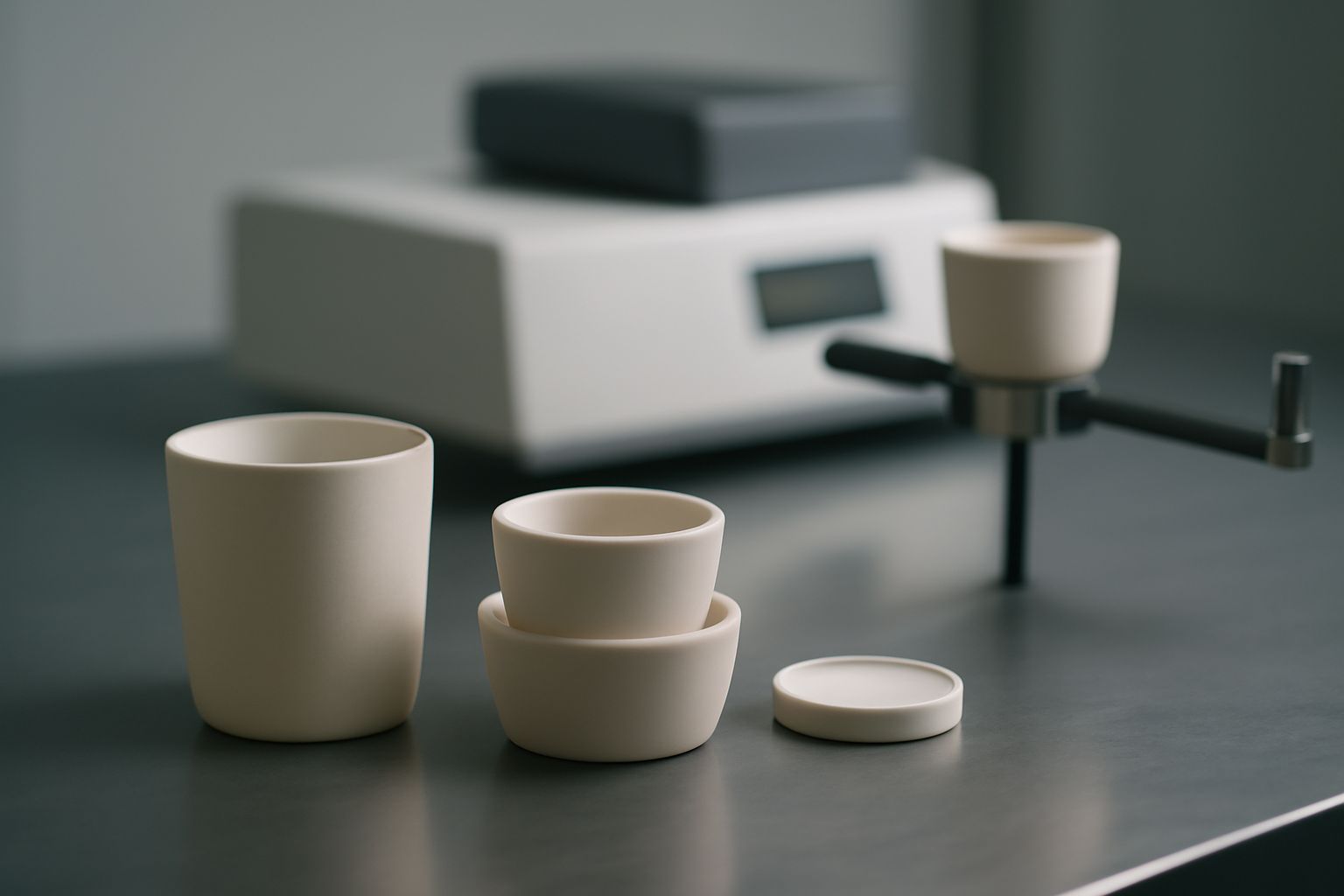
I learned that careful selection of crucibles and trust in reliable suppliers dramatically improved my lab’s data quality and reduced order issues. Getting these decisions right sets the foundation for all successful experiments. Let’s walk through the top considerations for buying crucibles.
Many buyers are frustrated by crucibles that don’t perform as needed. The key is knowing what features matter for your thermal measurement application before placing an order.
The focus should be on precise dimensions, compatible design, consistent batch quality, suitable certification, and easy handling for lab staff. Properly vetted features prevent later issues.
| Feature | Detail | Why It Matters |
|---|---|---|
| Dimension Accuracy | Consistent size within tight tolerance (±0.01mm) | Ensures snug fit and thermal contact for repeatable data |
| Surface Quality | Smooth, free from particulate or rough finish | Prevents sample loss and contamination (contamination) |
| Batch Certification | Verified by inspection and supplied with certificate | Guarantees consistent quality from lot to lot |
| Ease of Handling | Grippable rim, safe packaging | Reduces errors in fast-paced labs |
My lab saw fewer errors and faster instrument setup when we standardized on crucibles with strict inspection and uniform sizes from each lot.
The wrong material can lead to sample loss, reaction with chemicals, or even melting during high-temperature runs. This costs both time and trust in your data.
Picking the right material depends on the maximum temperature needed, sample reactivity, and value of purity. Matching these ensures both safety and precise results.
| Material | Core Property | Application Fit |
|---|---|---|
| Alumina | Chemical inertness, high melting point | Standard for many laboratories and ceramic research |
| Platinum | Excellent thermal stability, highest purity | Essential for trace analysis or regulated testing |
| Graphite | High heat resistance, handles corrosive samples | Useful in metallurgy and special crystal growth |
| Ceramic | Affordable, resists acids | Suited for general quality control needs |
I recommend confirming with your technical team and checking vendor specs—especially for new or valuable test samples—before selecting a crucible material.
Lab teams often run into issues when crucibles fit poorly or fail under certain thermal loads. Compatibility is about more than just dimensions.
Check the match between crucible design and equipment brand or model. Assess holder type, heating rate, sensor spacing, and max temperature capacity.
| Factor | Required Check | Effect on Measurement |
|---|---|---|
| Instrument Brand/Model | Supplier should give a cross-reference list | Ensures fit with devices like DSC or TGA |
| Thermal Expansion Rate | Test at high/low heat cycles | Prevents loosening or cracking mid-test |
| Sensor Accessibility | Probe should reach sample without interference | Avoids measurement lag or missed events |
| Heat Distribution | Uniformity in pan design | Improves signal clarity and repeatability |
My purchasing experience taught me that direct communication with suppliers about fit and function avoids many surprise issues.
Missed shipments and inconsistent quality hurt lab productivity and trust. Reliable suppliers prevent costly production lags and failed tests.
Trusted suppliers maintain inventory, support urgent orders, offer technical support, and keep quality high across every batch. This keeps labs productive and costs predictable.
| Reliability Aspect | Supplier Practice | Lab Benefit |
|---|---|---|
| Inventory & Lead Time | Ready stock, fast DHL/UPS shipment | Reduces downtime and avoids experiment delays |
| Technical Support | Answers on specs, model match, troubleshooting | Helps labs solve problems on short notice |
| Consistent Quality | Uses batch QC and provides certificates | Enables repeatable, accurate measurement (quality control) |
| Flexible MOQ | Accepts small orders for trials or custom work | Supports R&D, pilot projects, and small labs |
My lab kept running smoothly even in global supply crunches by having reliable partners who provided tracking, support, and even express stock for urgent tests.
Careful crucible procurement improves thermal data quality and keeps lab operations efficient. Reliable partners and accurate technical matches build a solid testing foundation.
Contact Technical Support

C082.Wangdefu International Building, Furong, Changsha, Hunan, China


+86-19907415020