



SHOPPING CART
Your cart is empty.
shop now
Your cart is empty.
shop now
Poor crucible material choices in DSC can produce false results, leading to expensive delays and flawed scientific conclusions in polymer and material analysis labs.
The most common DSC crucible materials are aluminum, platinum, and alumina. These materials offer a balance of heat resistance, chemical inertness, and reliability needed for precise thermal analysis experiments.
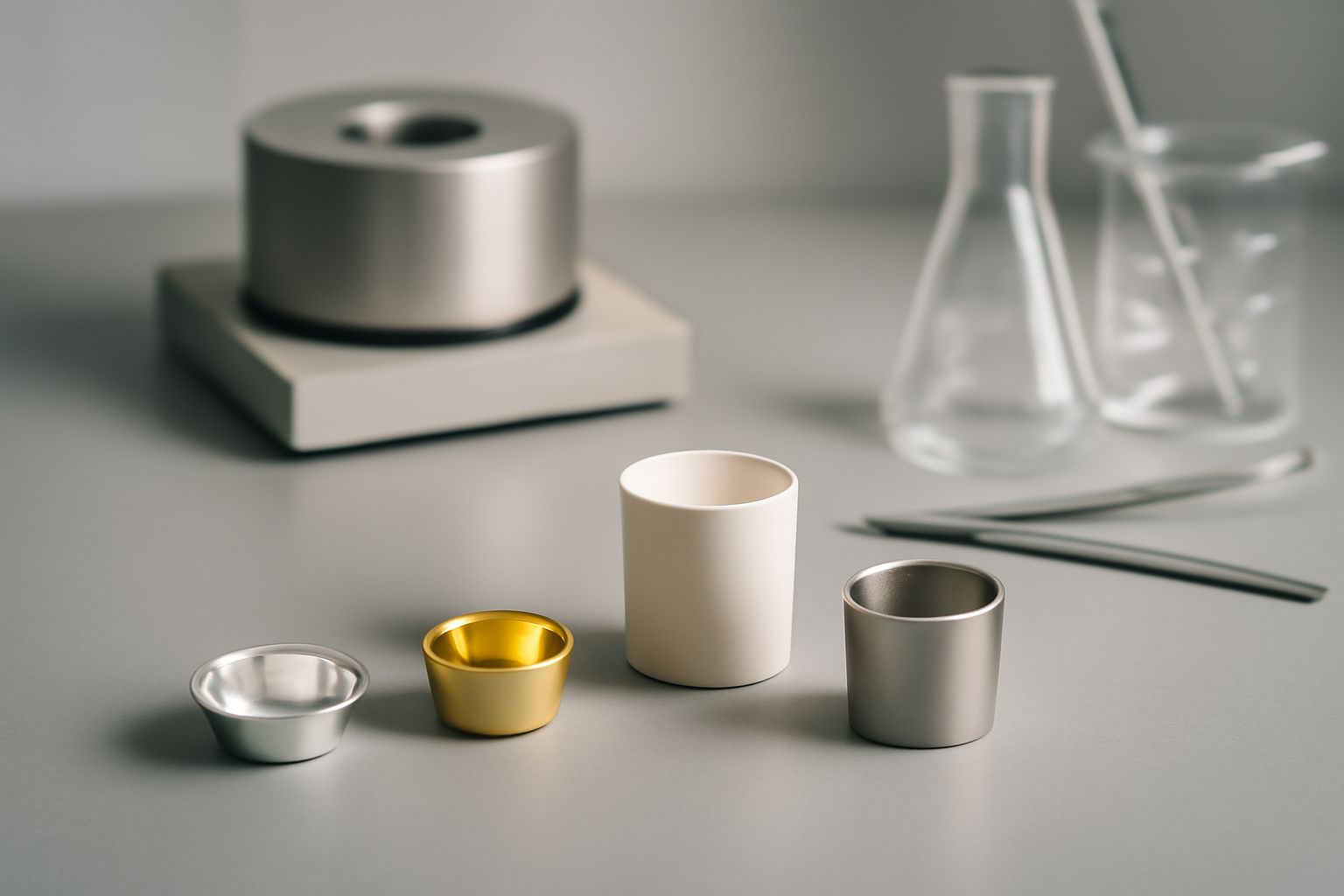
I have seen how switching to better crucible materials stopped baseline drift and improved thermal reproducibility in my lab. Understanding the differences behind each material type helps optimize every DSC result and reduces troubleshooting.
Picking the wrong crucible material can lead to melting, reactions, or inaccurate DSC results. Material compatibility is essential in every analysis step.
The most widely used crucible materials are aluminum, platinum, and alumina. Each offers thermal stability and low reactivity, serving different test needs in polymer, chemical, and pharmaceutical DSC applications.
| Material | Typical Use | Maximum Temperature (°C) | Chemical Stability |
|---|---|---|---|
| Aluminum | General polymer and organic analysis | 600 | Resists most organics |
| Platinum | High-temp, aggressive samples | 1600 | Excellent, inert to many chemicals (platinum info) |
| Alumina | Oxidizing and catalyst studies | 1600 | Stable in oxidizing atmospheres (alumina details) |
| Gold | Pharmaceuticals, volatile samples | 1000 | Very inert, less common due to cost |
| PTFE | Special, non-metal reactive compounds | 300 | Nonstick, some chemical resistance (PTFE facts) |
I usually start with aluminum pans for polymer work and only switch to platinum or alumina for high-temperature or corrosive studies. Selecting by test conditions ensures that my analysis matches accepted DSC methodology and avoids avoidable errors at the pan level.
Using a reactive or heat-sensitive crucible can compromise every DSC result. Materials that interact with samples or deform at test temperatures lead to wrong conclusions.
Material choice affects sample safety, contamination risk, the accuracy of detected transitions, and long-term reliability of DSC runs in all laboratory environments.
| Key Factor | Importance | Risk If Neglected |
|---|---|---|
| Thermal Stability | Ensures pan stays intact at high temp | Sample spills, distortion during runs |
| Chemical Inertness | Prevents unwanted reactions with polymer or catalyst | False peaks, unreliable data |
| Signal Integrity | Keeps data sharp and repeatable | Poor baseline, noise masking transitions |
| Cleanability/Reuse | Critical for multi-use pans | Cross-contamination between tests |
I check manufacturer specs for each lot and audit crucibles before new projects, especially when protocols demand high-precision results. In regulated labs, even a small mismatch can trigger retesting and more expensive research delays.
A mismatch in pan material creates misleading thermograms, inaccurate melting points, or strange artifacts. Data reliability starts with the right crucible.
Crucible materials influence baseline flatness, sensitivity, and temperature accuracy. Proper selection enhances detection of glass transitions, crystallization, and other events in complex samples.
| Material Property | Effect on Results | Best Use |
|---|---|---|
| Thermal Conductivity | Faster heat transfer, sharper peaks | Aluminum for regular polymer tests (thermal conductivity) |
| Heat Capacity | Lower capacity avoids baseline drift | Thin pans for accurate, small samples |
| Interaction/Inertness | Inert pans protect against reaction artifacts | Platinum or alumina for unknown or aggressive samples |
| Surface Finish | Reduces sticking, easier sample removal | Smooth finish minimizes contamination risk |
I once struggled with inconsistent melting points on proprietary polymers. The cause became clear after switching from generic to high-purity platinum pans. Now, I always verify the fit between my experiment and pan material—any analyst following polymer characterization best practices will see better and more repeatable results.
Researchers and QC labs depend on industry standards for assurance and reproducibility, especially in regulated polymers or pharmaceutical analysis.
Standards like ISO 11357 and ASTM E968 specify performance and purity guidelines for DSC crucible materials. Following these helps labs maintain quality, consistency, and international credibility.
| Standard | Focus Area | Implication for Labs |
|---|---|---|
| ISO 11357 | Polymer thermal analysis | Recommends crucible material/purity for glass transition and melting studies (ISO 11357 details) |
| ASTM E968 | DSC calibration and performance | Requires certified crucibles for method traceability (ASTM) |
| ISO 9001 | Quality management | Supplier traceability and batch certificates |
| RoHS/REACH | Environmental/safety compliance | Assures no restricted substances in material |
I always require ISO or ASTM documentation with pan orders for critical client work. These certificates help our lab secure project contracts and avoid disputes about traceability or purity. Pan material standards are now routine expectations in most laboratory settings worldwide.
Proper DSC crucible material selection—aluminum, platinum, or alumina—secures accurate, reliable heat flow measurements. Choose pans that meet international standards and are matched to each sample’s properties for every critical analysis.
Contact REDTHERMO Technical Support

C082.Wangdefu International Building, Furong, Changsha, Hunan, China


+86-19907415020