


SHOPPING CART
Your cart is empty.
shop now
Your cart is empty.
shop now
Many student labs struggle to find DSC crucibles that are both low cost and safe. Without clear specs, classroom results and budgets suffer.
Discount DSC crucibles for students must use ≥99.5% pure aluminum, 0.15–0.25 mm thick walls, and volumes around 20 μL to ensure safety, reliability, and compatibility for daily training experiments.
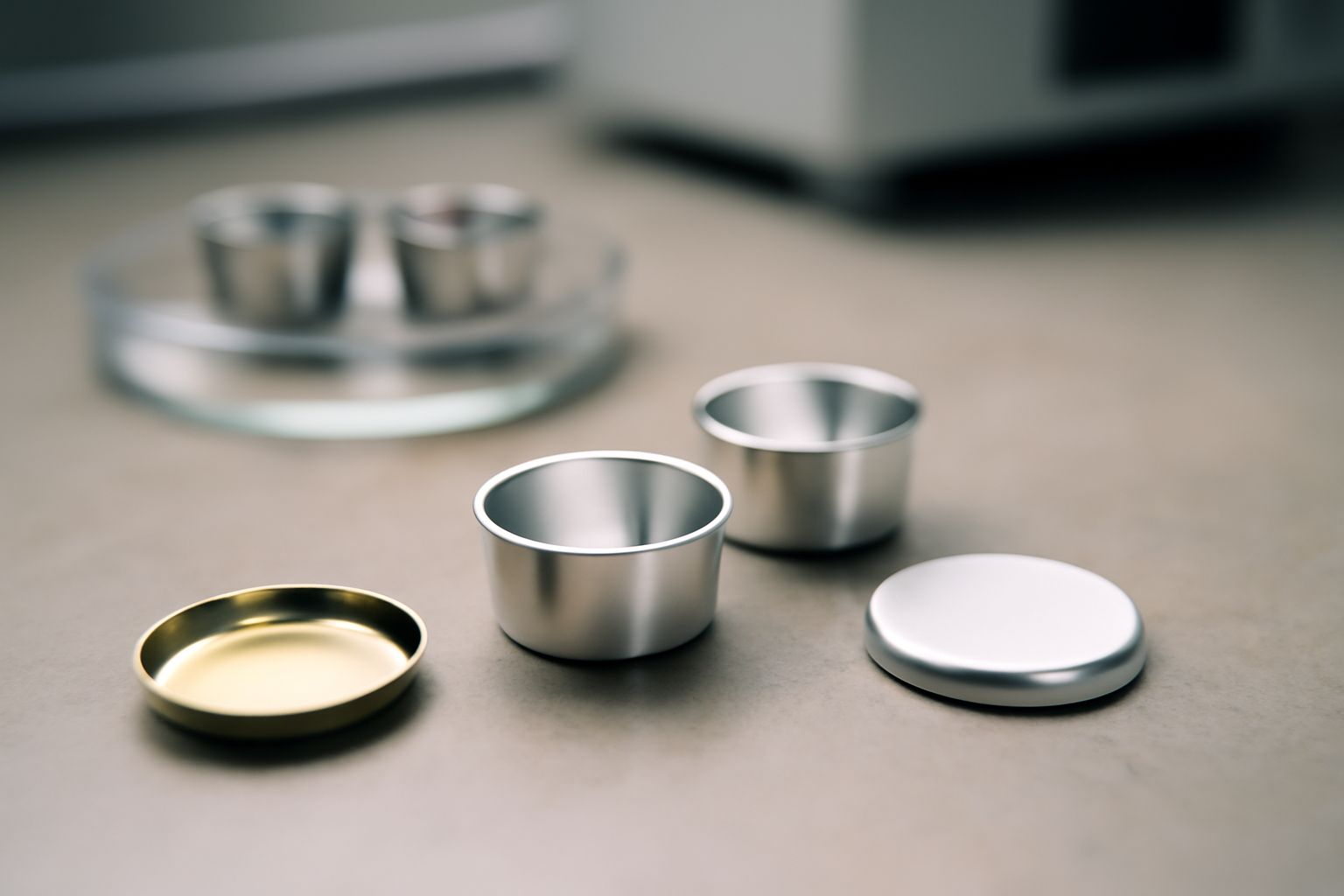
Students and lab coordinators care about both test accuracy and low cost—especially in a teaching setting. Well-chosen discount pans help keep skills sharp and budgets under control. Read on to find out what really matters in specs for student DSC crucibles.
Material choice affects every aspect of classroom DSC pan performance. Pick the wrong one, and you risk leaks, poor results, or higher expenses over time.
For student labs, pure aluminum is the most common and reliable choice. It provides sufficient heat conduction, is safe for most tests, and is compatible with standard DSC instruments, making it ideal for repeated hands-on lessons.
| Material Type | Key Features | Best Suited For | Compatibility |
|---|---|---|---|
| Aluminum | Good conductivity, cost-effective, easy to seal | General classes, organic & polymer tests | Most student DSC models |
| Gold-Coated | Resists corrosion, stable for volatile samples | Food, volatile, or sensitive chemicals | Selected DSC setups |
| Platinum | Extreme heat resistance, non-reactive | High-level research, thermal stability tests | Some advanced DSCs |
Most schools choose pure aluminum pans because they combine price, safety, and ease of use. Exotic crucibles like platinum are reserved for advanced or specialty DSC work due to their higher cost.
Lab accidents can start with overlooked details. If DSC pans lack proper purity or wall thickness, safety and results both suffer—even in student tests.
Student crucibles should use at least 99.5% pure aluminum and wall thickness between 0.15 and 0.25 mm. This range ensures enough durability for repeated handling and the right heat profile for education use.
| Parameter | Recommended Value | Purpose | Risks if Lower |
|---|---|---|---|
| Aluminum Purity | ≥ 99.5% | Test reliability & safety | Contamination, false readings |
| Wall Thickness | 0.15–0.25 mm | Durability, even heating | Fast cracks, uneven results |
Many classroom DSC pans list specs, but always check suppliers’ actual measurements and calorimetry standards. Proper specs keep learning and safety on track for teachers and students alike.
Too little or too much sample leads to errors in classroom experiments. Picking the right pan volume makes experiments more predictable for new learners.
For most student labs, DSC crucibles with a volume of 20–40 μL match standard test sample sizes. This range balances safety with convenience and helps students replicate industry test protocols in training exercises.
| Crucible Volume | Common Uses | Benefits for Students | Typical Sample Mass |
|---|---|---|---|
| 10–20 μL | Small-scale or costly samples | Less waste, fine control | 2–7 mg |
| 20–40 μL | Standard classroom tests | Fits most teaching exercises | 5–12 mg |
| 50–100 μL | Bulk samples or special cases | Demonstrations, group projects | 12–30 mg |
Choosing a volume outside typical student needs can raise errors. National laboratory guidance such as found in the ASTM D3418 standard supports these ranges for accuracy and classroom control.
Student mixtures can sometimes heat much higher than planned. Knowing the safe heat limit prevents warping or even small accidents in school labs.
Discount aluminum DSC pans for student labs can reliably work up to 600°C. For most standard educational experiments, this temperature range covers nearly all materials under test.
| Material | Recommended Max Temp | Typical Student Use Cases | Notes |
|---|---|---|---|
| Aluminum | 600°C | Polymers, organics, food | Melts at 660°C, but avoid near-limit use |
| Gold-Coated | 650°C | Corrosive or volatile tests | Better resistance for special samples |
| Platinum | 1500°C+ | High-temperature science classes | Rare in schools due to cost |
Most student labs never approach extreme heat. Still, always check a pan’s data sheet and safety instructions before running new material mixes at high temperature.
Careful specs for student DSC crucibles mean safe, reliable, and cost-controlled learning—exactly what student labs need most.
Contact Technical Support (info@redthermo.com)

C082.Wangdefu International Building, Furong, Changsha, Hunan, China


+86-19907415020