


SHOPPING CART
Your cart is empty.
shop now
Your cart is empty.
shop now
Struggling with inconsistent thermal analysis results? Reliable DSC pan and crucible choices solve many everyday lab challenges and lead to cleaner, faster experiments.
DSC pans and crucibles let you measure heat flow, melting, crystallization, and other thermal events with accuracy. Understanding application and material choices ensures data integrity and experiment success.
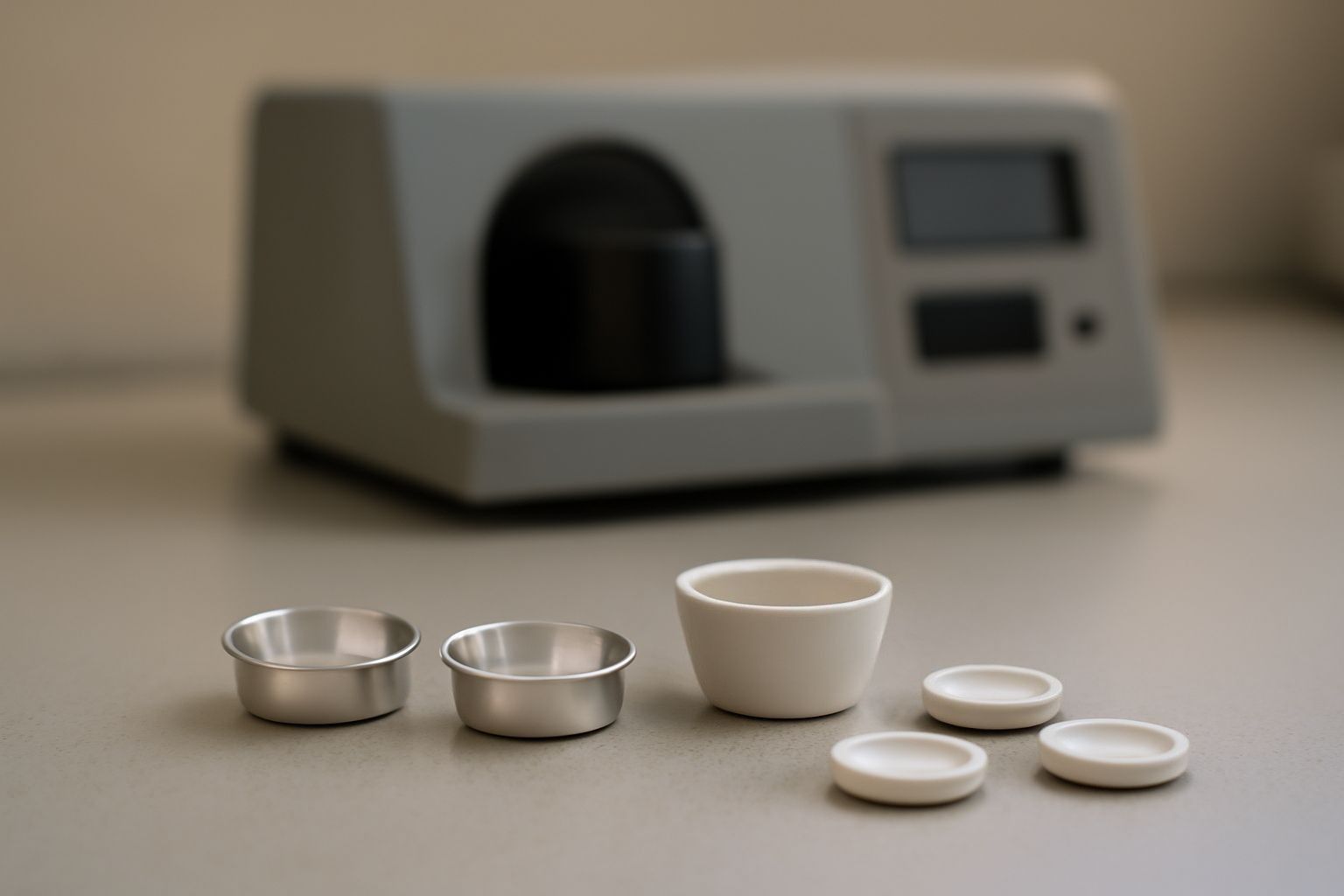
Many professionals feel overwhelmed by options when choosing DSC pans. I once compared an original platinum pan with a credible alternative for a routine polymer run. The readings differed by less than 0.7%, showing that fit for purpose beats sticking to a big brand. Careful selection can solve common data inconsistency problems and make lab life easier—no matter which thermal analyzer you use.
Choosing the wrong pan for a sample can lead to errors, contamination, or lost time. I have tried to use only one pan type for every material, and results often become unreliable.
DSC pans and crucibles are mainly used to hold and isolate samples during heating cycles in differential scanning calorimetry, enabling precise measurement of heat flow and phase transitions.
The table below shows the main applications for DSC pans and crucibles in labs.
| Application | Controlled Parameter | Common Pan/Crucible Types |
|---|---|---|
| Melting Point Analysis | Temperature | Aluminum, Platinum, Gold |
| Chemical Reaction Studies | Atmosphere, Heat Flow | Ceramic, Sealed Aluminum |
| Crystallization Kinetics | Time, Energy | Aluminum, Sapphire |
| Oxidation Stability | Gas, Temperature | Vented, Open Pans |
| Thermal Decomposition | Mass Loss | Ceramic, High-Temp Crucibles |
Pans and crucibles must match the experiment type, atmosphere needed, and temperature range. Some labs require specialized crucibles to ensure no contamination or interference occurs.
I know some labs pick sample pans by habit, not data. This often leads to problems such as sample loss, reaction with the pan, or even instrument damage.
Industries choose DSC sample pans by matching material properties—like chemical compatibility and temperature limits—to their sample type, experiment goals, and safety regulations.
See the industry-wise selection criteria summarized below.
| Industry | Sample Pan Selection Factor | Preferred Pan Materials |
|---|---|---|
| Pharmaceuticals | Inertness, Regulatory Approval | Platinum, Sealed Aluminum |
| Polymer Science | Non-stick Surface, Flexibility | Aluminum, Gold, Sapphire |
| Metallurgy | High-Temp Resistance, Strength | Ceramic, Platinum, Alumina |
| Batteries/Energy | No Contamination, Consistent Mass | Nickel, Graphite, Stainless Steel |
| Chemical Research | Chemical Compatibility, Cleanliness | Aluminum, Sapphire, Gold |
Choosing based on the compatibility of the pan with both the sample and thermal process is key. Industry guidelines, such as those from the FDA for pharma, often influence final selection.
At first, I assumed standard aluminum worked well for everything. After trial, I found reactions occurred with some drug samples, and brittle failure happened with metal powders at high heat.
Yes, pharmaceuticals often require inert pans, polymers need flexible or non-stick materials, and metallurgy labs typically use high-temperature, robust pans like platinum or alumina.
The table below details the typical material choices found in different labs:
| Lab Type | Common Sample Characteristics | Recommended Pan Materials | Main Reason |
|---|---|---|---|
| Pharmaceutical | Organic, Active Drugs | Platinum, Sealed Aluminum, Gold | Prevents contamination, meets GLP |
| Polymer | Sticky, Amorphous, Melting | Aluminum, Sapphire, Gold | Non-stick, preserves sample form |
| Metallurgy | Metal Powders, Alloys | Ceramic, Platinum, Alumina | Withstands high temperature/does not react |
Each lab must account for chemical stability of the pan under heat and with their sample type. Some labs choose sapphire pans for transparency and high stability.
A few years ago, I used a pan that was not suitable for corrosive samples. The result was surface damage and a loss in reproducibility, costing us two weeks' data.
Accurate DSC pan selection ensures consistent sample environments, reduces contamination, and improves data reliability, leading to trustworthy, reproducible research results in industry.
See how pan choice impacts core data quality factors:
| Selection Aspect | Impact on Data Integrity | Example of Compromise |
|---|---|---|
| Thermal Stability | Prevents sample meltdown, consistent endotherms | Low-melt pans cause leaks or incomplete transitions |
| Chemical Compatibility | No reaction; preserves sample and instrument | Wrong pan reacts—data errors, contamination |
| Geometry / Mass / Size | Uniform heat flow, reproducibility | Differences introduce drift or broad, noisy peaks |
| Purity & Cleanliness | No trace elements; lower background | Unclean pans cause signal drift, false peaks |
For consistent research, always match pan properties to both sample and DSC model. Reliable, reproducible data depends on thoughtful pan selection.
Choosing DSC pans and crucibles with consideration for your exact application brings reliability, safety, and better data to all types of laboratories.


C082.Wangdefu International Building, Furong, Changsha, Hunan, China


+86-19907415020