



SHOPPING CART
Your cart is empty.
shop now
Your cart is empty.
shop now
Poor pan choices ruin data in DSC labs, even for skilled analysts. Stable, well-designed heat-resistant pans form the base for every trustworthy result in thermal analysis.
The right heat-resistant pans in DSC experiments prevent deformation, avoid contamination, and support precise heat flow measurement, directly increasing reliability and overall experiment success in materials research.
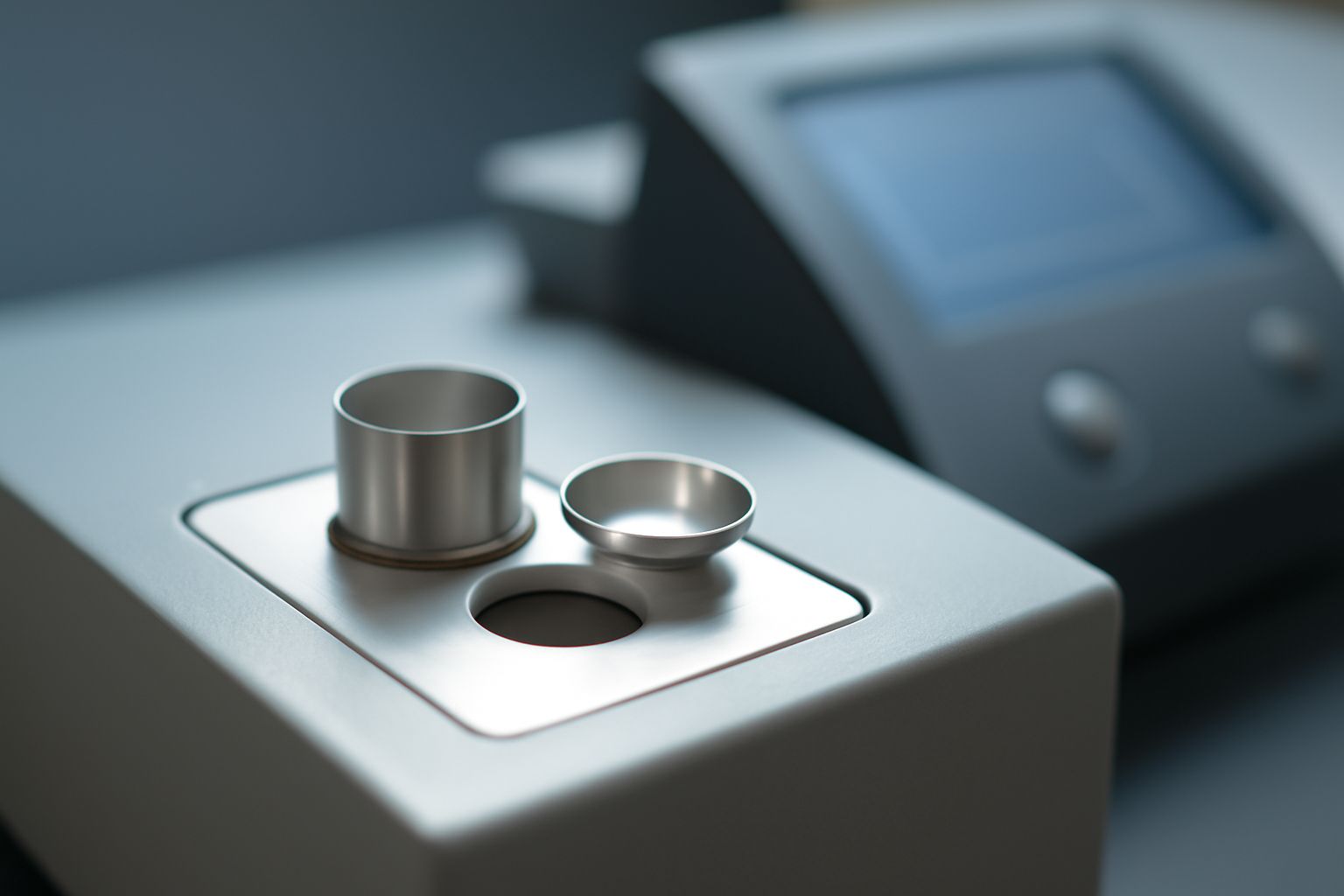
I have helped labs troubleshoot unclear DSC data only to find the problem traced back to poor pan selection or concealed defects. Material science now benefits from new composites and precision engineering in pan production. Each section here demystifies how pan choice and design affect the science and outcome of DSC runs, and how innovation opens fresh opportunities in thermal analysis.
Pans that deform or react at high temperature block accurate energy measurement and cause faulty baselines. Proper pans enable clean, interpretable DSC data.
Heat-resistant pans steady the baseline, prevent unwanted reactions, and allow a full temperature range, supporting repeatable, reliable data in every experiment.
| Contribution | Experimental Benefit | Failure If Ignored | Resource |
|---|---|---|---|
| High-temp stability | Prevents pan warping, stable backgrounds in runs | Shifting or noisy heat flow values | Heat resistance |
| Chemical inertness | Blocks sample-pan reactions, no extra/ghost peaks | Contaminated or altered material analysis | Chemical inertness |
| Uniform heat transfer | Sharp peaks, good phase transition clarity | Blurry/smeared melting/crystallization points | Heat transfer |
I have seen even experienced teams misdiagnose data drift, only to trace the issue to thin or impure pans. Steady, certified pans are my control in method validation projects, allowing me to untangle machine, sample, or operator changes and defend my results when publishing or presenting data.
Pan design and advanced materials impact how accurately and reliably a DSC captures thermodynamic events. Small differences can change sensitivity and lifetime.
Design impacts pan fit, seal, and sample exposure. Material—whether platinum, high-purity aluminum, or ceramic—sets limits for temperature, corrosion, and overall robustness.
| Design/Material | Performance Feature | Experimental Impact | More Info |
|---|---|---|---|
| Flat vs. deep well shapes | Surface area/exposure for variable sample types | Prevents spillage or improves heat flow for viscous samples | Calorimeter |
| High-purity aluminum | Inert base for most polymers and organics to ~600℃ | Reduces drift, cost-effective, reliable for routine runs | Aluminum |
| Platinum | Enables ultra-high temp, strong oxidation resistance | Reusable, optimal for metals/inorganics >1000℃ | Platinum |
| Ceramic composites | Outstanding for new demanding experimental setups | Handles wider temp/chemical ranges, robust in harsh protocols | Ceramic |
I now use ceramic-based pans for cutting-edge polymer tests that previously warped metals. When comparing DSC performance, I match pan design closely to my sample’s phase and volume, cutting error and strengthening method transfer to other operators or sites.
DSC data is only trustworthy when pan, method, and QC align each run. Failures often stem from inconsistent supplies or maintenance slips.
To achieve consistency, always use batch-tested pans, keep a strict log of cycles, clean and inspect before use, and do duplicate/blank runs for every key experiment.
| Consistency Method | Routine | Reason | Further Info |
|---|---|---|---|
| Batch tracking | Track lot numbers, certificate scan in QC logs | Identify drift or contamination by batch | Batch production |
| Duplicate/blank analyses | Run with unknowns or new pan lots | Catch differences, ensure baseline trust | Reproducibility |
| Routine re-inspection | Critical before long runs or key sample lots | Detects wear/contamination early | Quality control |
| Clean, dry, dedicated storage | All pans returned to labeled bins after use | Reduces contamination, mix-ups | Storage |
Years ago, my results for unknown polymer samples improved dramatically when switching from mix-and-match pans to log-traced batches. By adopting blank and replicate runs, I could maintain confidence when presenting results to collaborators, regulators, or during peer review.
R&D in pan materials and production now happens as fast as in the devices themselves. New capabilities mean higher confidence and broader research horizons.
Recent innovations in DSC pans include advanced ceramic composites, digital batch tracking, one-use and reusable hybrid designs, and tight-tolerance automation-ready models for high-throughput labs.
| Innovation | Lab Impact | Example/Use | Further Resource |
|---|---|---|---|
| Ceramic composite pans | Higher temp and chemical resistance, longer life | Extreme polymer, battery, or inorganic work | Ceramic |
| Barcode/RFID batch tracking | Simplifies audits, cuts human error in experiments | University and pharma compliance labs | RFID |
| Hybrid reuse models | Balance cost, waste, quality for budget-focused labs | High-use university teaching or research projects | Reusable |
| Automation-ready designs | Faster setup for robotic and parallel analysis | Large industrial or university research centers | Lab automation |
I follow rapid advances in thermal analysis pan R&D every year for my own group. Most new pans now prioritize both precise tolerance and smart tracking—features that raise standards and speed up experiments industry-wide. I expect next-gen materials and hybrid designs to soon cover nearly every need found in both basic and demanding research.


C082.Wangdefu International Building, Furong, Changsha, Hunan, China


+86-19907415020