


SHOPPING CART
Your cart is empty.
shop now
Your cart is empty.
shop now
Precision in thermal analysis depends on pans and crucibles with tightly controlled sizes, surface finish, and material properties. Misunderstanding these factors can risk all data quality.
Standard DSC pans typically span 5.0–8.5 mm in diameter, with thickness down to 0.1 mm. Their micron-level tolerances (≤±0.01 mm) ensure accurate calibration and robust reproducibility in sample testing.
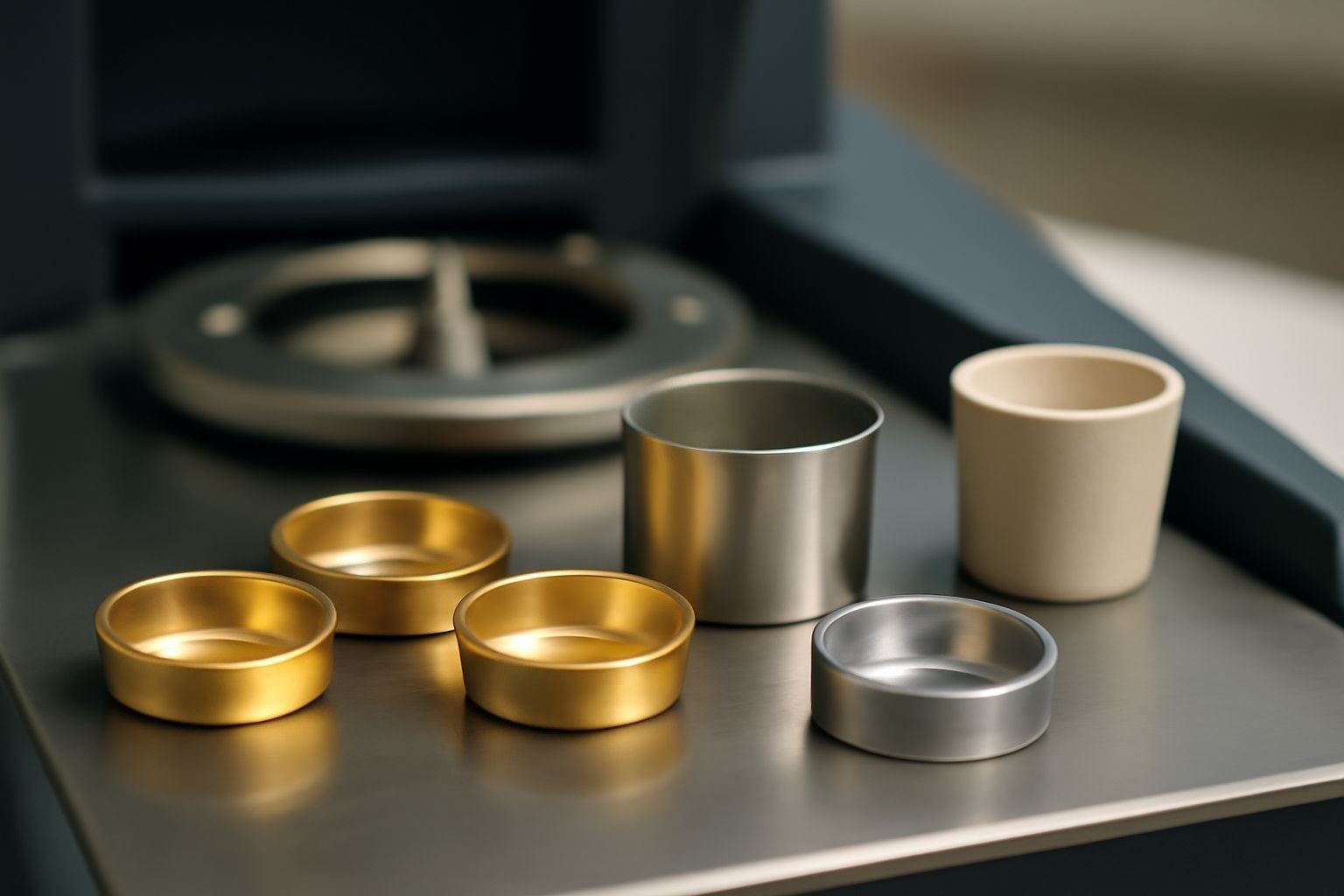
High-quality DSC results demand attention to detail. Each lab manager relies on clear pan specs, using the right tolerances, sealing, and materials to avoid invalid or unrepeatable data. I have seen labs lose weeks to avoidable cup mismatch. Good choices let experiments run smoother and cost less.
Thermal analysis comes down to details. Even a minor error in pan size or thickness can alter thermogram results or calibration.
The usual DSC pan size ranges from 5.0–8.5 mm in diameter, with heights around 2–4 mm and thickness between 0.1–0.3 mm. Tolerance is almost always held to ≤±0.01 mm.
| Pan Type | Diameter (mm) | Height (mm) | Thickness (mm) | Tolerance (mm) | Compatible Brands |
|---|---|---|---|---|---|
| Standard Aluminum | 6.0–7.0 | 2.2–3.0 | 0.1–0.2 | ≤±0.01 | METTLER, TA Instruments, PerkinElmer |
| High Volume Crucible | 8.5 | 3.8 | 0.3 | ≤±0.01 | NETZSCH, Shimadzu |
| Ceramic (Alumina) | 6.0–7.0 | 2.5–3.5 | 0.12 | ≤±0.01 | Hitachi, Linseis |
Maintaining tolerance is one of the most critical steps. Instrument specs set allowed variation. Straying beyond this range may cause failed calibration or poor repeatability, which is why precise measurement tools are used by suppliers and labs.
Using the wrong material or thickness can skew results, slow responses, or lead to untrustworthy thermograms. Making the right pick is essential for accurate research.
Most labs use pans made with aluminum or platinum for their purity and thermal response. Thickness (0.1–0.3 mm) impacts sensitivity, speed, and baseline drift. Purity above 99.9% is crucial too.
| Pan Material | Key Advantages | Typical Thickness (mm) | Thermal Conductivity (W/m·K) | Heat Stability (°C) |
|---|---|---|---|---|
| Aluminum | Fast heat transfer, low cost | 0.12–0.15 | 237 | up to 660 |
| Platinum | Superior chemical resistance, durable | 0.20–0.25 | 71.6 | up to 1700 |
| Ceramic | Non-reactive, high temperature | 0.15–0.20 | 18–30 | up to 1800 |
Pan material purity prevents chemical reactions with samples that may skew test results. Aluminum pans respond fast but do not handle high temperatures. Ceramic holds shape at elevated temperatures, but its lower conductivity affects peak resolution. Platinum handles reactive or acidic samples well. Sources: R. Hüther, Thermochimica Acta, vol. 447 (2006), and manufacturer technical datasheets.
Many labs get puzzled by the choices. Each material—aluminum, platinum, ceramic—plays a different role for distinct applications or sample requirements.
Aluminum is standard for routine DSC. Platinum is for high-temperature or reactive substances. Ceramic excels for oxidation resistance or aggressive samples.
| Pan Material | Best For | Drawbacks | Sample Compatibility |
|---|---|---|---|
| Aluminum | Organic, polymers, food, standard DSC | Low max temperature, not for acids | Most polymers, pharmaceuticals |
| Platinum | High-temp, oxidation, corrosive samples | High cost, risk of sample adhesion | Inorganic, metals, acids |
| Ceramic | Extreme temperatures, highly reactive | Moderate response speed, brittle | Oxidizers, battery, glass |
When selecting, match each pan to your DSC application. I typically use aluminum for day-to-day polymer labs and switch to ceramic if working with unknown organic samples or batteries. Platinum suits high-temperature studies. Brand suppliers always list compatible materials for their models. Source: Shimadzu Application Notes and manufacturer guidelines.
Test reliability often comes down to correct pan sealing. A poorly sealed pan can lose sample, gain unwanted water, or leak volatiles mid-test.
Pressed, crimped, and hermetic sealing all prevent contamination but offer different benefits. The sample stability during heating depends on the right choice.
| Sealing Type | Application | Strengths | Weaknesses |
|---|---|---|---|
| Pressed/Lid-on | Simple solid samples, non-volatile | Quick, easy, for fast runs | Leaks for liquids or volatile compounds |
| Crimped | Weakly volatile compounds | Better sealing than pressed, easy to automate | Pressure-sensitive, care needed |
| Hermetic | Strongly volatile, long tests | Air-tight, no mass loss, best for precise mass | Requires good tool, correct alignment |
Picking the correct hermetic seal reduces chance of evaporation or contamination. High-precision analysis of pharmaceuticals or foods often demands sealed, crimped pans. Routine polymer work uses pressed or standard crimped lids. Each type impacts baseline drift and loss of volatiles during heating.


C082.Wangdefu International Building, Furong, Changsha, Hunan, China


+86-19907415020