


SHOPPING CART
Your cart is empty.
shop now
Your cart is empty.
shop now
Standard pans rarely fit the demands of challenging tests. I have watched research teams struggle with failed measurements due to the wrong holder fit or design.
By customizing thermal analysis sample holders, you match the geometry, material, and performance needs of any complex test, ensuring stability and precise results.
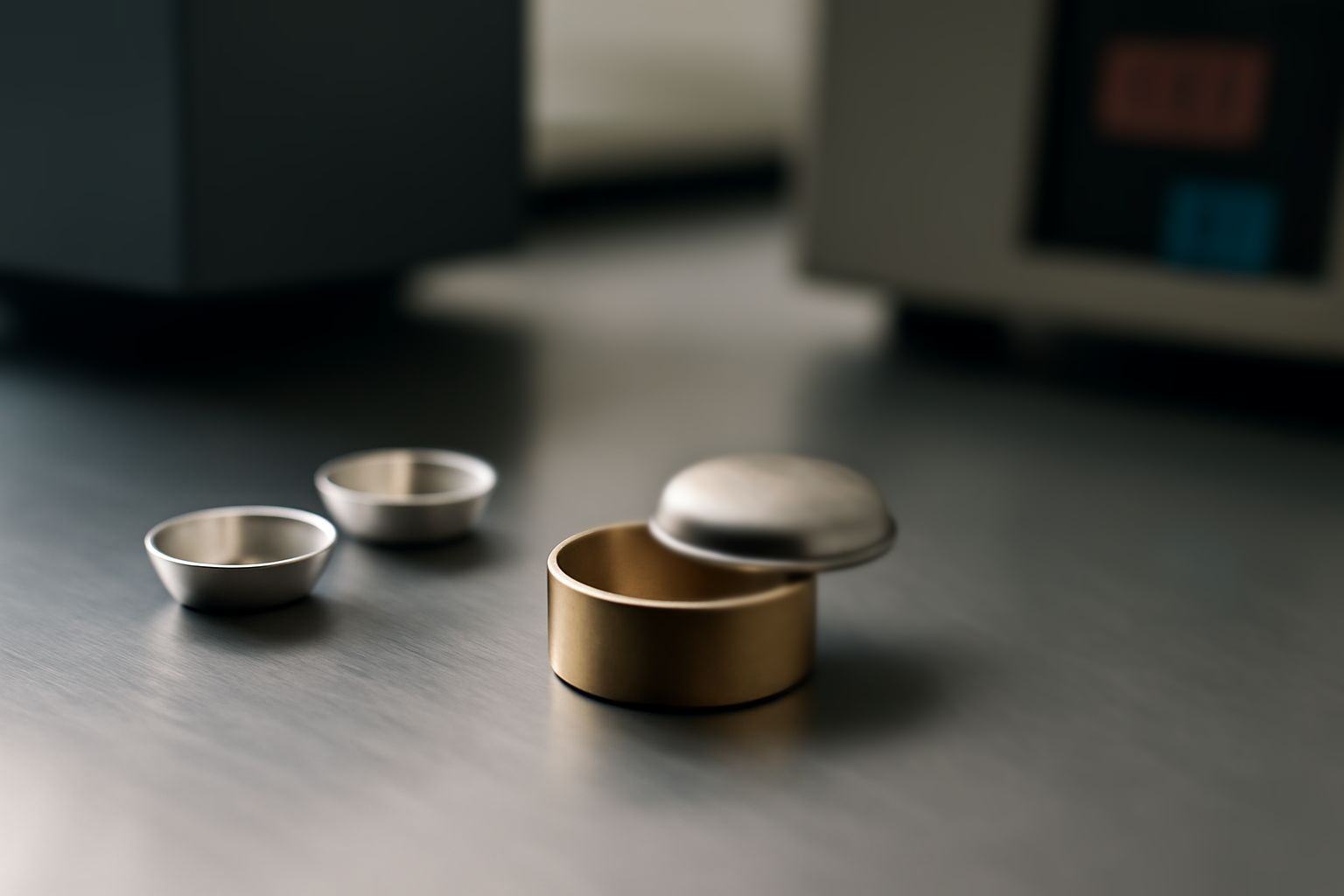
As technology evolves, so do the demands for advanced, reliable analysis. My own projects in materials and environmental science pushed me to explore customization like unique venting or high-temperature coatings. When I chose the right tailored holder, my data quality improved and costly downtime dropped. Let’s look at how custom solutions meet real lab challenges.
Samples for pharmaceutical tests or polymers often don’t fit generic pans. I needed holders with exact dimensions and sealing functions to keep volatile materials safe.
Sample holders are adapted for complex tests by changing shape, size, lid styles, or surface treatments based on the goal and sample properties.
| Adaptation | Benefit | Use Case | Reference |
|---|---|---|---|
| Custom Shape/Volume | Enables accurate measurement | Fragile or non-standard samples | DSC analysis |
| Special Lids | Improves sealing and safety | Volatile, reactive materials | Supplier technical note |
| Surface Coating | Boosts resistance to chemicals | Corrosive samples, high purity needs | Surface coatings |
| Precision Machining | Ensures tight fit, no leakage | Micro-volume studies, isotopic tests | Instrument datasheet |
Complex research issues usually require made-to-order holders. When I worked with low-boiling solvents and needed a perfect seal, I specified unique lids and coatings, then saw performance increase. These changes match literature guidance from thermal analysis handbooks.
Working in aerospace and high-temp ceramics, I often needed pans to survive aggressive heat and rapid temperature shifts no stock part could handle.
Custom pans are engineered with materials like platinum, ceramics, or gold to tolerate extreme temperature, pressure, or chemical exposure during advanced testing.
| Material Option | Max Tolerance | Extreme Condition | Limitation |
|---|---|---|---|
| Platinum | 1600°C | High-heat, oxidation, repeated cycling | High cost |
| Ceramic | 1200°C | Chemical or oxidative abuse | Brittle, fragile in shock |
| Gold Coating | 1000°C | Corrosive and high-purity tests | Limited mechanical strength |
| Heat-Resistant Alloys | 800–1400°C | Thermal shock, rapid cycling | Less chemically inert |
Extreme condition tests like those in TGA need custom-built pans that can handle back-to-back thermal cycles. Proper engineering avoids pan distortion and keeps your readings valid, as confirmed by REDTHERMO’s quality assurance data (2024).
Custom holders only justify their investment when they boost data quality or solve practical lab bottlenecks. I looked for measurable improvements before switching any design.
Changes in material, geometry, or lid sealing impact heat transfer, leak resistance, and measurement repeatability in all routine and advanced tests.
| Customization | Direct Impact | Best Suited For | Documentation |
|---|---|---|---|
| Shape/Volume Adjustments | Improves heating uniformity | Irregular or bulk samples | Supplier blueprints |
| Lid and Seal Mods | Reduces sample evaporation | Volatile or pressurized samples | Gasket specs |
| Material Upgrades | Boosts resistance to reaction | Aggressive chemistry, repeated use | Lab reports |
| Surface Finish Options | Less sticking, easy cleaning | Food, biological samples | Case studies |
Changing a single variable often yields measurable performance gains. After switching to custom volumes and non-stick coatings, my own test series delivered fewer errors—just as quality assurance manuals advised.
I have witnessed entire labs transform their daily workflow through one smart holder redesign. These case studies prove the value of an open mind to customization.
Real-world success comes from working closely with trusted suppliers, sharing drawings or prototypes, and verifying each detail before full production.
| Scenario | Challenge | Custom Feature | Result |
|---|---|---|---|
| Ceramic R&D | Material decomposition tests | Special offset lid, high-temp ceramic | Stable readings to 1200°C |
| Pharma Stability | Volatile solvent evaporation | Gasket-sealed crimp lid | Zero solvent loss, repeatable DSC data |
| Environmental Studies | Soil with variable composition | Custom volume, vented holders | Accurate mass loss tracking |
| Polymer R&D | Low-boiling point samples | Gold coating, thick rim | Reduced pan warping, valid TGA results |
These and similar stories—originally documented in scientific journals—reveal steady benefits: faster workflows, better data, and lower per-test costs. I follow up with project partners to confirm if changes are still holding up six months later.
Customized sample holders bridge the gap between unique lab needs and reproducible results, making complex testing easier and more dependable across research fields.

C082.Wangdefu International Building, Furong, Changsha, Hunan, China


+86-19907415020