



SHOPPING CART
Your cart is empty.
shop now
Your cart is empty.
shop now
If your results change for unknown reasons, the wrong DSC sample pan could be the culprit. Get pan choice right and protect your sensitive samples from start to finish.
For the best DSC results in a home lab, always match your pan to your sample’s needs. Use inert pans for reactive or sensitive materials, seal if moisture loss matters, and handle everything with clean tools.
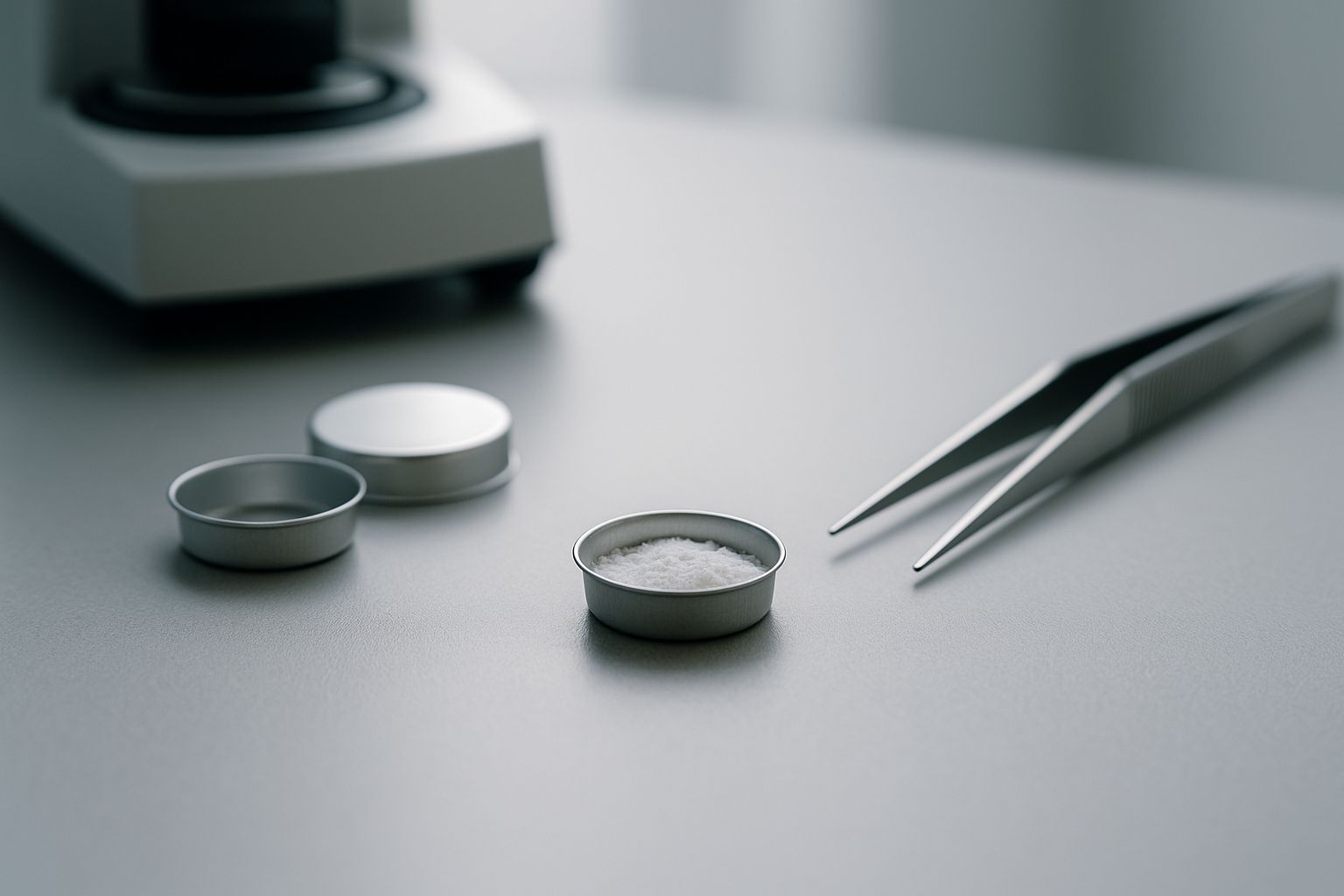
Many home-lab users face challenges in picking the proper sample pan for their critical tests. I have encountered failed runs and inconsistent baselines just from overlooked pan selection details. Let’s look at solutions that actually work. If reliable results are your goal, understanding these best practices is essential. From matching pan type to polymer or drug, to preventing contamination and choosing the right sealing, keep reading for advice you can use today.
Incorrect pan type can ruin sensitive sample analysis. Picking the proper aluminum, platinum, or sealed pan prevents errors and uncovers true thermal behavior.
Select aluminum pans for most polymer or food work. Pharmaceuticals may require more inert metal or tightly sealed pans. Always check your sample’s reactivity, expected temperature, and volatility before choosing.
| Sample Category | Recommended Pan | Why | Extra Advice |
|---|---|---|---|
| Polymer | Aluminum (standard/sealed) | Good thermal match; most are non-reactive. | Seal for low-Tg or volatile polymer; avoid recycled pans. |
| Pharmaceutical | Aluminum, Platinum, or Gold | Inert metals prevent drug interaction, suit temperature range well. | Use sealed pans for light/moisture sensitive drugs. |
| Food | Aluminum (flat/low-mass) | Easy heat transfer, low background, fits food greases, sugars. | Handle with gloves to avoid grease residue. |
Every sample group reacts differently inside a DSC. Certain drugs may still react with metals. Always double-check your pan's inertness if you test unstable or newly developed compounds. This data keeps you confident in both food and pharma studies at home. Custom or standard DSC pans can help achieve reproducibility for a range of materials.
Tainted samples lead to bad data. Simple mistakes like dirty tweezers or fingerprints can ruin even the most careful DSC test.
Use gloves, clean every tool before and after, and always handle pans in a dust-free spot. Limiting air contact protects sensitive or hygroscopic samples.
| Step | What to Do | Importance | Tips |
|---|---|---|---|
| Glove Up | Wear new, powder-free gloves. | Prevents hand oil or sweat transfer. | Change gloves if interrupted. |
| Tool Cleaning | Wipe tweezers, spatulas with isopropyl alcohol. | Removes micro debris and past contaminants. | Dry tools with clean tissue, air-dry fully. |
| Pan Handling | Only touch pans with clean tweezers. | Keeps pan surface uncontaminated. | Hold pans by rim, never the bottom. |
| Workspace Check | Work under a clean hood or closed area. | Prevents airborne dust or fibers ruining the sample. | Cover assembled pans with foil until start. |
Small steps add up in contamination control. The tiniest grease or skin contact can alter heat flow baselines. Some home users set up low-cost laminar flow setups, which mimic a real cleanroom environment, to improve pan prep. Always document every cleaning process for audit or troubleshooting.
Leaving pans unsealed can cause water loss or sample aging. For most moisture-sensitive DSC runs, sealed pans are a must.
Use hermetic aluminum pans to protect water-rich, volatile, or air-sensitive materials. Proper sealing prevents drying, bubbling, or escape of key compounds in the heat.
| Sample Type | Risk If Unsealed | Pan Choice | Proof of Protection |
|---|---|---|---|
| Hydrates (food, drugs) | Loses water, signal drops | Hermetic seal (press-seal) | Stable peaks, no baseline drift |
| Volatile organics | Evaporates, lowers mass | Sealed, vented cap | No sample loss, real onset temps |
| Standard polymers | Often fine as open, unless additive loss risk | Open or crimp as needed | Typical heat/cool cycles work |
Main studies in moisture analysis by DSC show water will escape in normal lab air in minutes. Sealed pans trap critical sample parts in, giving correct energy curves and melting points. Sealing devices and accessories are widely available. Small test runs help spot leaks before a major study.
Too much sample can overflow or alter the baseline. Too little may not register at all. Correct pan, sample, and method sizing is crucial for repeatable home lab DSC results.
Match your sample size to your pan volume. Test 3–10mg for most home DSC setups, adjusting pan depth or shape for bulky or hard-to-melt items.
| Sample Weight | Best Pan Type | Outcome | Common Error |
|---|---|---|---|
| <2 mg | Low-mass or small-volume pan | Sharper, fast response; may need more repeats | Noise, hard to pick up transitions |
| 2–10 mg | Standard aluminum flat pan | Good for most DSC signals; easy to reference | Spill if pan is shallow |
| 10–30 mg | Deep-well or reinforced pan | Needed for food, greases, or foams | Chaotic data if pan poorly sealed |
Choosing the right capacity, especially for very small or large samples, stops overspill and prevents skewed heat flow. Pan specs are found in every DSC manual. Adjust for accuracy: reduce sample for very sensitive studies, use deeper pans if foaming or expansion may happen during heating.


C082.Wangdefu International Building, Furong, Changsha, Hunan, China


+86-19907415020